
PDO Threads: The Complete Guide
PDO Threads: The Complete Guide (2026)
5000+ words covering everything: what PDO threads are, how they work, benefits, every thread type, PDO vs PLLA vs PCL, treatment areas, lifespan, recovery, risks, cost — plus wholesale sourcing for clinics.
Key Takeaways
- PDO threads dissolve in 3-6 months; results typically last 6–9 months, often longer.
- Three core types — Mono (collagen), Cog (lifting), Screw/Tornado (volume) — choose by treatment goal.
- PDO is the entry-level, most widely used material; PLLA (18–24 mo) and PCL (12–18 mo) are longer-lasting premium options.
- Most complications are mild and technique-related; prevention starts with product quality and training [2][3].
- For clinics: wholesale quality = USP Class VI material + EO sterilization + documented batch traceability.
In this guide:
What Is a PDO Thread?
PDO stands for polydioxanone — a colorless, biocompatible, medical-grade synthetic polymer used in absorbable surgical sutures since the 1980s. In aesthetic medicine, PDO threads are ultra-fine sutures (typically 26G to 30G, down to 18G for structural work) inserted under the skin to lift lax tissue, smooth wrinkles, and stimulate collagen production.
The defining properties of PDO as a material:
- Fully absorbable — the polymer hydrolyzes and is cleared by the body within 4–6 months.
- USP Class VI biocompatibility — the same implant-grade standard used in cardiac and orthopedic surgery, giving PDO a 40-year clinical safety record [4].
- Proven collagen response — PDO activates fibroblasts, increasing collagen I/III deposition around the thread channel, with a peak at 3–6 months [1].
Understanding the material explains the results. Polydioxanone is a crystalline polymer whose degradation is hydrolytic — it breaks down into safe, water-soluble byproducts that the body clears without residue. Two engineering properties matter clinically:
- Tensile strength retention: PDO retains roughly 50% of its tensile strength at 3 weeks and the majority of its lifting force for the first 1–2 months — the window during which mechanical lift is most active. After that, the collagen scaffold progressively takes over .
- Elastic memory: the polymer's crystalline structure gives threads a controlled flexibility that reduces tissue drag during insertion — a property that depends on manufacturing quality and is one reason needle gauge and polish matter.
Because degradation is fully hydrolytic, PDO leaves no permanent foreign material — a decisive advantage for patients who want a non-surgical option without long-term implant concerns.
If you are new to thread lifting, start with our beginner explainer: What Are PDO Threads?
What the Clinical Evidence Says
In aesthetics — a YMYL (Your Money or Your Life) category — claims must be grounded in verifiable sources. The published evidence on PDO threads is consistent on four points:
- Collagen stimulation: PDO threads activate fibroblasts and increase collagen I/III deposition around the thread channel, with the effect peaking 3–6 months after placement.
- Safety profile: a 2021 review in Dermatologic Therapy found that most thread-lift complications are mild and technique-related — bruising, dimpling, and thread extrusion — with serious adverse events rare when practitioners are properly trained .
- Anatomical practice: current literature emphasizes that safe, effective lifting depends on correct thread type selection and anatomical placement, reinforcing the value of certified training .
- Absorption kinetics: PDO loses tensile strength within weeks and is fully hydrolyzed in 4–6 months, while the collagen scaffold persists well beyond thread resorption .
How Does a PDO Thread Lift Work?
A PDO thread lift is a non-surgical procedure performed in 15–60 minutes under local anesthesia. A licensed practitioner inserts threads through sterile needles or cannulas into the subcutaneous layer, then gently pulls them to lift and anchor the tissue.
- Consultation & marking — the practitioner assesses skin laxity and marks entry points.
- Anesthesia — local numbing of the treatment area.
- Thread insertion — fine threads are placed via sterile needles or cannulas.
- Lift & anchor — the practitioner pulls to lift tissue; cog threads anchor mechanically.
- Post-procedure — patients return home immediately; most resume work the same day.
Two effects happen simultaneously: an immediate mechanical lift, and a long-term collagen remodeling that continues for 3–6 months after placement . Candidate selection and detailed expectations: What Is a PDO Thread Lift?
Benefits of PDO Threads
PDO threads are the most widely used absorbable thread worldwide, and for good reason. The key benefits:
- Non-surgical lift — visible lifting without scalpel, general anesthesia, or hospital stay.
- Minimal downtime — most patients return to work the same day.
- Natural collagen regeneration — instead of replacing tissue, PDO triggers your own collagen production .
- Versatility — treatable areas include face, jawline, brow, eyes, nose, neck, chin, lips, cheeks, and body.
- Immediate + progressive results — instant lift plus improving results over 3–6 months.
- High safety profile — 40-year absorbable-suture history, USP Class VI material.
- Affordable entry point — significantly lower cost than surgical facelift.
- Combinable — synergizes with botulinum toxin, fillers, and microneedling. See our combination guide.
Independent patient-community data supports the satisfaction picture: on RealSelf, 76% of reviewed thread-lift patients rate the procedure "Worth It" .
From a clinic business perspective, PDO threads also make commercial sense: low material cost per treatment, short chair time (15–60 minutes), high repeat-visit potential (maintenance every 6–12 months), and an easy upsell pathway from skincare-only clients to their first minimally invasive procedure. For distributors, the category's growth is driven by the global shift toward non-surgical aesthetics — a market that continues to expand as patients seek visible results without surgery.
None of these benefits replaces a thorough candidacy assessment. The thread is a tool; the practitioner is the decision-maker. When both are right, the combination of immediate lift and progressive collagen regeneration makes PDO threads one of the most versatile tools in the non-surgical aesthetic cabinet.
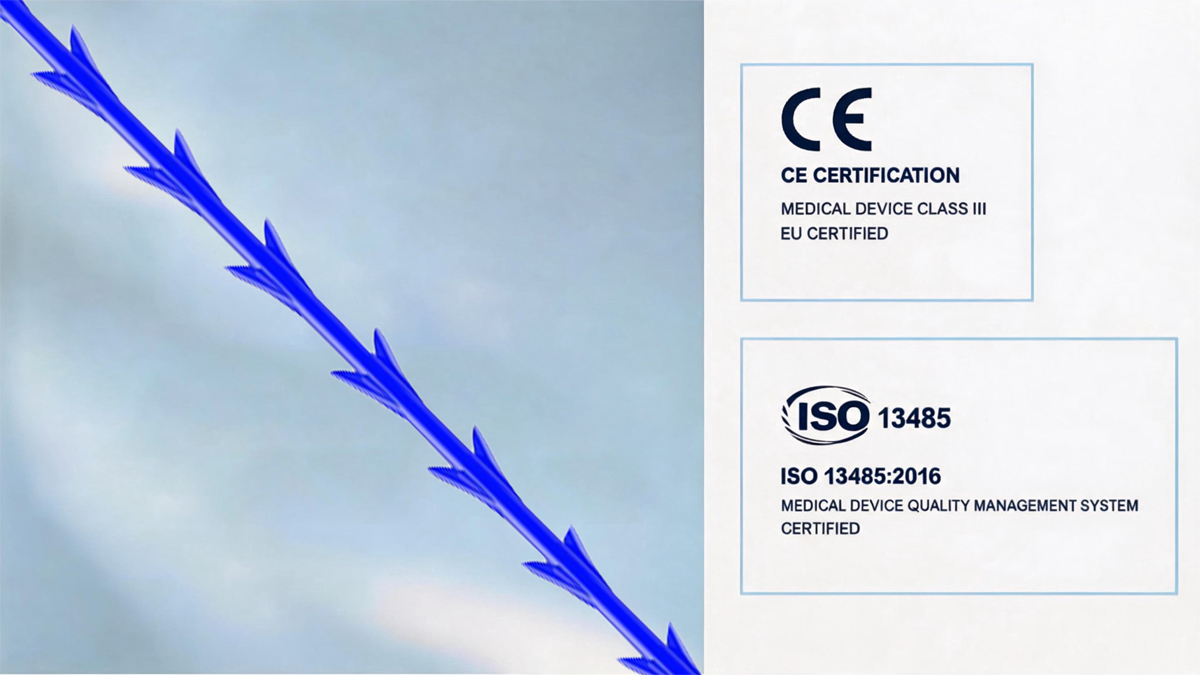
PDO Thread Types: Mono, Cog, Screw & More
Threads are engineered by structure — each design has a distinct clinical role. Choosing the right type is the most important decision in any thread lift protocol.
Each type in more detail:
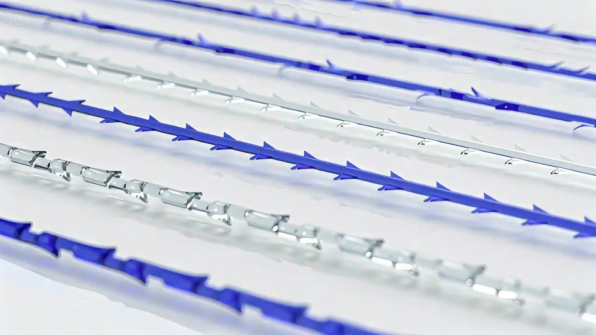
- Mono threads are smooth, single-strand threads used primarily for collagen stimulation and fine-line smoothing — ideal for first-time clients and full-face protocols. See mono threads guide.
- Cog threads carry barbs that anchor into tissue, delivering true mechanical lifting for jawlines and brows. See cog threads guide.
- Screw and Tornado threads use coil designs that compress tissue for volume restoration in small areas like the nose and lips. See screw threads guide.
For protocol planning (gauge selection, needle matching, area mapping), see our complete thread type comparison.
Shop by type: PDO Mono Thread 26G · Tornado Screw Thread · PDO Cog Thread with Cannula · Cog 3D/4D/6D
PDO vs PLLA vs PCL: Which Material for Which Client?
PDO is not the only absorbable thread material. PLLA (poly-L-lactic acid) and PCL (polycaprolactone) threads offer longer-lasting alternatives. The choice is a clinical decision, not a marketing one:
| Feature | PDO | PLLA | PCL |
|---|---|---|---|
| Absorption | 4–6 months | 12–18 months | 12–18 months |
| Collagen effect | Moderate stimulation | Strong, long-term regeneration | Sustained bio-stimulation |
| Result duration | 6–9 months | 18–24 months | 12–18 months |
| Best for | Fine lines, first-time clients | Full-face rejuvenation, advanced aging | Jawline, mid-face, structural lift |
Best Treatment Areas
PDO threads can be used on nearly any area of the face and body where skin laxity or volume loss is a concern:
- Face — mid-face lift, cheek volume, nasolabial folds. Full face guide
- Jawline — jowl softening, definition, profile sharpening. Jawline threads guide
- Eyes & Brow — brow elevation, crow's feet, fox-eye look. Eye lift guide
- Nose — non-surgical augmentation with screw/tornado threads. Nose thread lift guide
- Lips & Cheeks — lip border, cheek volume. Lip threads guide
- Neck & Chin — neck tightening, double-chin improvement. Neck & chin guide
Thread selection by area follows the anatomy:
- Eyes and lips — finest gauges (30G) and mono or screw threads; tissue here is thin and delicate, and over-aggressive lifting is counterproductive.
- Nose — screw and tornado threads are the standard for tip definition and bridge augmentation because their coil structure adds volume without a visible anchor point.
- Jawline and chin — cog threads (22G–18G) deliver the anchoring force needed for jowl lifting and profile definition.
- Mid-face and cheeks — a combination of cog for support and screw for volume is the common protocol.
- Neck — mono threads are preferred for the neck's thin skin; cog threads are used cautiously and only by experienced practitioners.
Every area guide on this site includes a protocol recommendation table so practitioners can build treatment menus without guesswork.
How Long Do PDO Threads Last?
Two timelines matter, and confusing them is the most common source of misinformation:
- Thread resorption: 4–6 months — the polymer is hydrolyzed and cleared.
- Clinical result: typically 6–9 months, often longer, because the collagen scaffold persists after the thread is gone [1][4].
Duration varies with thread type (cog > mono), treatment area, age, skin quality, and lifestyle. Smoking and excessive sun exposure shorten results. A realistic expectation conversation protects both the patient and the clinic. Week-by-week detail: How Long Does a PDO Thread Lift Last?
Five factors that measurably affect how long results last:
- Thread type and gauge: cog threads (12–18 months of lift support) outlast mono threads (6–9 months); thicker gauges anchor more tissue but are not suitable for delicate areas.
- Treatment area: areas with heavy movement (nasolabial folds, around the mouth) break down threads faster than static areas.
- Patient age and skin elasticity: younger skin with higher baseline collagen production retains results longer.
- Lifestyle: smoking accelerates collagen degradation; UV exposure damages the newly formed collagen scaffold; weight fluctuation affects facial volume.
- Aftercare compliance: massage avoidance in the first two weeks and sun protection are strongly associated with better retention.
For maintenance, most clinics schedule touch-up treatments at 9–12 months — typically fewer threads than the initial session, because the collagen base persists. This repeat cycle is also the reason many clinics offer thread-lift membership packages.
Recovery & Aftercare
PDO thread lifts are "lunchtime procedures," but proper aftercare determines how long results last and how smooth recovery is:
| Timeline | What to Expect |
|---|---|
| Day 1 | Mild swelling/tenderness; sleep on back, head elevated |
| Days 2–3 | Swelling peaks then fades; no facial massage |
| Week 1 | Avoid strenuous exercise, wide yawning, gum |
| Weeks 2–4 | Full activity; tightness when smiling is normal |
| Months 2–4 | Collagen remodeling peaks — final results visible |
Key aftercare rules: avoid blood-thinning medication/alcohol 24–48h before; no facial massage or aggressive skincare for 2 weeks; no sleeping face-down for 5–7 days; wear sunscreen daily. Complete do's and don'ts: PDO thread aftercare guide
A practical aftercare checklist practitioners give patients:
- First 24 hours: keep the head elevated, apply cold compresses, avoid touching or washing the treated area aggressively, and avoid makeup on insertion points.
- Days 2–7: gentle cleansing with lukewarm water, no exfoliation, no steam rooms or saunas, no alcohol, and no strenuous exercise that raises blood pressure.
- Weeks 2–4: avoid facial massage, heavy skincare devices (e.g., ultrasonic or RF devices over treated areas), and dental procedures that require wide opening of the mouth.
- Ongoing: daily sunscreen (SPF 30+), adequate hydration, and topical skincare that supports collagen (retinol, vitamin C — introduced only after week 2).
Patients should report persistent pain, asymmetry, or signs of infection immediately. Most complications are caught early when patients are given clear instructions and a direct line to the clinic.
Risks & Side Effects
Polydioxanone has a 40-year record in absorbable surgery. In aesthetic use, the evidence shows most adverse events are mild and technique-related: bruising, swelling, dimpling, and thread extrusion [2]. Serious complications are rare when threads are placed by trained practitioners using verified products.
- Expected & temporary: swelling, bruising, mild soreness, tightness — resolve within days.
- Rare & manageable: dimpling, migration, extrusion — technique-related and preventable [2].
- Product-side risk control: USP Class VI material, EO sterilization, batch documentation.
Cost & Pricing
Wholesale prices (clinics/distributors): driven by thread type, gauge, needle configuration, and volume — and this is where manufacturer-direct sourcing changes the economics. Full breakdown for both sides: PDO thread lift cost guide · request wholesale quote
Wholesale PDO, PLLA & PCL Threads — Direct from Manufacturer
Private label & OEM · 30+ countries
Request Wholesale Pricing & SamplesPDO Threads for Professionals
Auro Technology Limited manufactures the full thread range — mono, cog, screw, tornado, mesh, and multi-needle from 26G to 18G — and exports to 30+ countries. What clinics and distributors should verify before buying:
- Material certificate — USP Class VI or equivalent biocompatibility documentation.
- Sterilization validation — EO process, batch records, expiry dating.
- Traceability — lot numbers on every box for post-market vigilance.
- Training support — proper technique is the biggest safety variable; confirm the supplier offers or recommends certified training.
Sourcing & training: supplier selection guide · PDO thread training · full PDO collection · PDO surgical suture
How working with AuroThread typically proceeds:
- Inquiry and qualification: share your clinic type, target markets, and volume — we send documentation (material certificates, sterilization validation, packaging specs) before any order.
- Samples and evaluation: evaluate samples against the five quality criteria above; most clinics decide within 2–3 weeks of evaluation.
- First order and training: bulk pricing from 50 units; we support onboarding with product documentation and can direct you to certified training partners.
- Private label and OEM: custom branding, packaging design, and mixed-SKU containers are available for distribution businesses.
- Ongoing supply: stable lead times, batch documentation per shipment, and responsive technical support.
We export to 30+ countries and serve clinics, med-spas, and distributors — start the conversation here.
How to Choose the Right PDO Thread Type
Selecting the correct thread type is a clinical decision that determines both the result and the safety profile. A practical decision framework:
- Goal = skin texture and fine lines: use mono threads (26G–30G). They deliver collagen stimulation with minimal risk and are the standard first-line option for first-time clients.
- Goal = structural lifting (jawline, brow, jowls): use cog threads (18G–23G). The barbs anchor mechanically, providing the strongest lift of the PDO family.
- Goal = volume restoration in small areas (nose, lips, nasolabial folds): use screw or tornado threads, whose coil structure compresses and supports tissue.
- Goal = broad-area support: use mesh threads for larger zones where volume and even support are needed.
- Budget and protocol efficiency: multi-needle and double-needle configurations reduce procedure time for full-face protocols.
Needle gauge selection follows the same logic: finer gauges (30G) suit delicate areas like the eyes and lips; thicker gauges (18G–22G) suit structural lifting where anchoring force matters. Our thread type comparison maps every configuration to its clinical use.
PDO Thread Lift Results: What to Expect
Setting correct expectations is essential in thread lifting, because the result evolves over months. The typical journey:
- Immediately after: visible lift, partly masked by swelling; mild bruising and tightness are common.
- Week 1: swelling and bruising fade; the lift becomes clearer.
- Month 1: most side effects resolve; collagen remodeling begins.
- Months 2–4: collagen production peaks — skin texture, firmness, and lift visibly improve [1].
- Months 5–9: results plateau and gradually fade as the scaffold remodels; maintenance treatments extend the effect.
Realistic expectation management is also a risk-management tool: patients who understand the two timelines (thread absorption vs. result duration) report higher satisfaction, consistent with patient-community data .
PDO Threads vs Dermal Fillers
Threads are often compared with two other non-surgical mainstays. They are not competitors — they are complementary tools:
| Treatment | Primary Action | Best For | Duration |
|---|---|---|---|
| PDO Threads | Mechanical lift + collagen stimulation | Sagging, laxity, texture | 6–9 months |
| Dermal Fillers | Adds volume | Volume loss, deep folds, lip augmentation | 6–24 months |
In practice, combination protocols are common and increasingly evidence-supported: threads provide the structural lift, fillers restore volume, and neurotoxins relax dynamic wrinkles. This is why our combination treatment guide is one of the most-read resources on the site.
Thread Quality & Safety Standards: The Manufacturer's View
We believe product quality is the single most underrated variable in thread lifting. Two identical protocols can produce very different outcomes depending on the product behind them. What separates medical-grade threads from commodity products:
- Material certification: USP Class VI (or equivalent) biocompatibility testing covers systemic toxicity, implantation, and sensitization — the same standard applied to implant-grade sutures. Request the certificate; reputable manufacturers publish it.
- Sterilization validation: EO sterilization must be validated per batch, with biological indicators and residual EO testing. A 2-year shelf life requires stability data, not a guess.
- Batch traceability: every box should carry a lot number linking to production records, sterilization runs, and QC release documents. This is your post-market vigilance system.
- Needle quality: insertion force, bevel geometry, and cannula matching directly affect tissue trauma and patient comfort. Gauge tolerance matters at 26G–30G.
- Packaging integrity: peel-open sterile packaging with clear expiry dating — packaging defects are a leading cause of sterility breach in transit.
Clinics should audit suppliers on these five points before purchase. Our supplier selection guide turns this into a practical checklist, and our surgical suture collection documents the standards we apply to our own products.
Who Should Avoid PDO Threads?
Responsible content also covers when not to treat. PDO threads are contraindicated or should be approached with caution in:
- Pregnancy and breastfeeding.
- Active skin infections, inflammation, or open wounds in the treatment area.
- Known allergy to polydioxanone or related polymers.
- Autoimmune disorders or uncontrolled systemic disease (assessed case by case).
- Patients with unrealistic expectations about result duration — the biggest driver of dissatisfaction [5].
Thread lifting must be performed only by licensed practitioners who assess candidacy. Full clinical considerations are in our complications & risks guide.
Common Myths About PDO Threads, Clarified
Misinformation travels faster than clinical evidence. The most common myths we encounter — and the facts:
- Myth: "Threads are just threads — brand doesn't matter." Fact: material grade, sterilization validation, needle polish, and batch traceability vary significantly between manufacturers, and these variables affect both results and safety. This is why we publish our standards openly.
- Myth: "Results are permanent." Fact: PDO is fully absorbable; results typically last 6–9 months. PLLA and PCL offer longer durations (up to 18–24 months) but none are permanent.
- Myth: "More threads always mean better results." Fact: thread count follows a clinical plan — area, laxity, and anatomy. Over-treatment increases complication risk without proportional benefit.
- Myth: "Thread lifts replace facelifts entirely." Fact: threads address mild-to-moderate laxity. Advanced ptosis still requires surgical lifting — honest candidacy assessment protects both the patient and the practitioner.
- Myth: "Anyone can learn thread lifting in a weekend." Fact: complications are predominantly technique-related [2]; certified, supervised training is the single most effective safety measure.
How PDO Threads Are Manufactured
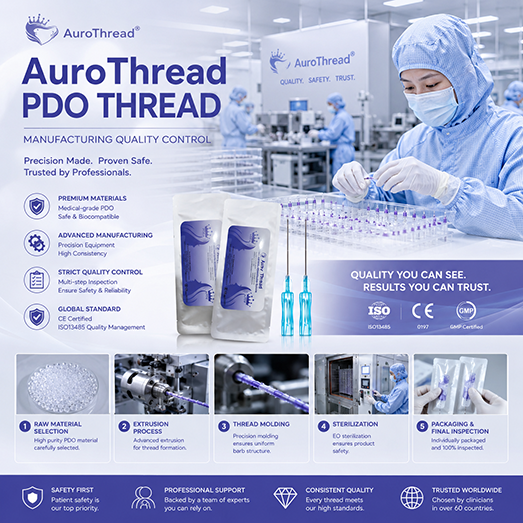
Few resources explain how threads are actually made — yet manufacturing quality is where clinical outcomes are decided. The process at a USP Class VI facility follows these stages:
- Polymer synthesis and extrusion: pharmaceutical-grade polydioxanone resin is melt-extruded into monofilament with controlled diameter tolerance. Even 0.01 mm deviations matter at 30G.
- Thread forming: mono threads are polished; cog threads are barbed via precision cutting; screw threads are coiled — each step is geometry-critical and inspected under magnification.
- Needle attachment and assembly: medical-grade stainless needles are swaged to the thread; cannula variants require matched-diameter assembly to prevent tissue drag.
- EO sterilization: ethylene oxide sterilization with biological indicators per batch, followed by aeration to remove residuals — validated, not assumed.
- QC release and traceability: tensile strength, diameter, barb integrity, sterility, and packaging integrity tests; a lot number is assigned to every box linking it to full production records.
This is why "medical-grade" is a claim you can verify — and why our manufacturing standards guide walks through each quality checkpoint in detail.
The Business Case for Adding PDO Threads to Your Clinic
Beyond the clinical picture, PDO threads are one of the most attractive service lines for aesthetic clinics. The economics work at every stage:
- Low entry cost: a full protocol uses a handful of threads — material cost per treatment is a fraction of the patient price ($300–$1,500 per session).
- Short chair time: 15–60 minutes per treatment enables high daily volume without expanding rooms or staff.
- Recurring revenue: maintenance cycles at 9–12 months create a predictable repeat-client base — the metric clinics care about most.
- Upsell pathway: thread lifting naturally follows skincare, microneedling, and filler consultations, increasing average client value.
- Minimal regulatory overhead: compared with devices that require dedicated facilities, thread lifting fits existing treatment rooms with standard sterilization protocols.
For distributors, the category fundamentals are equally strong: absorbable-thread demand is growing with the global shift toward non-surgical aesthetics, and supplier differentiation now centers on documentation quality and consistency — both of which are AuroThread's focus.
Conclusion
PDO threads remain the entry point of the absorbable-thread market — the most studied, most widely used, and most affordable way to deliver a non-surgical lift with natural collagen regeneration. The clinical picture is well established: absorbable material with a 40-year surgical history [4], mild and technique-related complication profile [2], and results lasting 6–9 months on average [1].
For clinics and distributors, the two variables that decide outcomes are product quality (USP Class VI material, EO sterilization, traceability) and technique (training). Both are controllable — and both are why we publish this guide openly rather than relying on marketing claims.
Start with our full PDO thread collection, or contact our wholesale team for samples and pricing.
This guide will be updated quarterly in line with our content-maintenance policy. Bookmark it, or explore the rest of the PDO Thread Academy — every section above links to a dedicated in-depth guide, and every guide links back here, building the topic authority that makes this site the reference for absorbable threads.
FAQ (20 Questions)
1. What are PDO threads?
Absorbable, medical-grade polydioxanone sutures used for non-surgical lifting and collagen stimulation. Threads dissolve in 3-6 months while results persist. See also: What Are PDO Threads?
2. How long do PDO threads last?
Threads dissolve in 3-6 months; results typically last 6–9 months, often longer, depending on type, area, and patient factors.
3. How long does a PDO thread lift procedure take?
15–60 minutes, depending on the treatment area and the number of threads used.
4. Do PDO thread lifts hurt?
Under local anesthesia, most patients report only mild discomfort and a tugging sensation. Mild soreness for 2–3 days afterward is normal.
5. Are PDO threads safe?
PDO is a USP Class VI material used in surgery since the 1980s. Risks are low with trained practitioners; rare complications are technique-related [2]. See our complications guide.
6. What is the difference between mono, cog, and screw threads?
Mono stimulates collagen; cog lifts with barbs; screw/tornado restores volume in small areas. Full comparison: PDO thread types.
7. How much does a PDO thread lift cost?
Patients: $300–$1,500 per session typically. Clinics: wholesale pricing depends on type, gauge, and volume — request a quote.
8. What areas can be treated with PDO threads?
Face, jawline, eyes, nose, lips, cheeks, neck, chin, and body — see treatment areas.
9. Can PDO threads be combined with other treatments?
Yes — commonly with botulinum toxin, dermal fillers, and microneedling for synergistic results. See our combination guide.
10. Are PDO threads better than a surgical facelift?
Different tools for different cases: threads offer non-surgical lift with minimal downtime and 6–9 months of results; surgery offers permanent structural correction with higher cost and longer recovery. A licensed practitioner determines candidacy.
11. I read that PDO results fade after a few weeks — is that true?
Early "results" in the first weeks are partly swelling-related; the collagen-building effect peaks at 3–6 months [1]. Realistic expectation: 6–9 months of visible benefit, longer with cog threads and good skin care.
12. How many PDO threads do I need?
Typically 1–15+ threads per session depending on the area, skin laxity, and protocol. A full-face protocol commonly uses more; the practitioner decides after assessment.
13. How soon will I see results?
An immediate lift is visible right away, but swelling can mask it for a few days. Progressive collagen results appear over 3–6 months [1].
14. Who is a good candidate for PDO threads?
Adults with mild-to-moderate skin laxity who want a non-surgical option. Advanced sagging may need surgical lift or heavier (cog/multi-needle) protocols — candidacy must be assessed by a licensed practitioner.
15. What is the recovery time after PDO threads?
Most patients resume work the same day; bruising and swelling typically resolve within 1–2 weeks. Full activity resumes within 2–4 weeks.
16. Are PDO threads permanent?
No — PDO threads are fully absorbable and dissolve in 3-6 months. The collagen they stimulate persists, which is why results outlast the threads themselves.
17. Can I buy PDO threads wholesale?
Yes — AuroThread supplies PDO/PLLA/PCL worldwide with OEM/private label. Browse collection or contact wholesale team.
18. Do I need training to perform PDO thread lifts?
Yes — thread lifting is an invasive medical procedure. Certified training is essential; most complications are technique-related [2]. See PDO thread training.
19. How do I choose a PDO thread supplier?
Verify USP Class VI material certification, EO sterilization validation, batch traceability, and training support. Full checklist: supplier selection guide.
20. What is the difference between PDO, PLLA, and PCL threads?
PDO absorbs in 3-6 months (results 6–9 months); PLLA in 12–18 months (results 18–24 months); PCL in 12–18 months (results 12–18 months). PDO is the entry option; PLLA/PCL are longer-lasting premium choices.
21. What is the best thread for nasolabial folds?
Screw and tornado threads are the standard choice for nasolabial folds: their coil structure restores volume and supports the fold without the visible anchor points of cog threads. Mono threads can be added for texture improvement. Area-specific protocols are detailed in our lip & cheek guide.
22. Can PDO threads be removed?
Most complications — dimpling, puckering, or visible threads — can be managed: mild cases resolve as swelling subsides; persistent issues are corrected by gently pulling or removing the thread, which trained practitioners can do in-office. Because PDO is absorbable, spontaneous removal of the material is not required; the thread dissolves in 3-6 months regardless. See our complications guide.
23. How many PDO thread sessions are needed?
Most protocols achieve the target result in one session; a top-up at 9–12 months maintains it. Some practitioners split full-face treatments into two sessions two weeks apart to manage swelling and fine-tune the lift. Repeat treatment is safe and common because the material is fully absorbable with no cumulative burden.
24. Do PDO threads work for everyone?
No treatment works for everyone. PDO threads are most effective for mild-to-moderate laxity in adults with reasonable skin elasticity. Very thin skin, advanced ptosis, or active skin conditions reduce candidacy. A licensed practitioner's assessment — not a marketing claim — determines suitability.
About the Authors & Medical Review
Written by the AuroThread R&D Team — Review date: August 17, 2026.
References
1. Kim J, et al. Clinical study of collagen regeneration after PDO thread insertion. J Cosmet Dermatol. (PDO-induced collagen I/III deposition, peak 3–6 months.)
2. Wiley, Dermatologic Therapy (2021). Thread lift safety and complication review. doi:10.1111/dth.13446.
3. Wiley, Journal of Cosmetic Dermatology. Anatomical considerations for thread lifting. doi:10.1111/jocd.16618. Open access.
4. FDA device classification database — absorbable surgical sutures, polydioxanone (USP Class VI).
Educational content only — not medical advice. Results vary by individual. Always consult a licensed medical professional for treatment decisions. © 2026 Auro Technology Limited. All rights reserved.