
PDO vs PLLA vs PCL Threads
PDO, PLLA and PCL are the three absorbable polymer families used in modern thread lifting. They are often sold side by side, occasionally confused, and regularly oversimplified in clinic marketing materials. This article is the authoritative comparison: what each material actually is, how the three differ in absorption timeline, collagen response, effect duration, flexibility, and clinical indication — and a practical selection framework that tells you when each material earns its place in the protocol.
Each material in this family has its own dedicated guide. Start here for the overview, then dive into the one that fits your clinical question. For the broadest foundation, see PDO Threads: The Complete Guide.
On this page:
- What are PDO, PLLA and PCL threads?
- Complete specification comparison
- Collagen stimulation: how each material works
- Clinical indications by material
- Gauge and design range by material
- Selection framework: when to choose each material
- AuroThread product range
- Frequently asked questions
What Are PDO, PLLA and PCL Threads?
All three are absorbable, biocompatible synthetic polymers approved for use as lifting sutures in aesthetic medicine. Once placed under the skin they trigger neocollagenesis — the body's own collagen-manufacturing response — and depending on the design, may also provide an immediate mechanical lift. The fundamental difference between the three is how long they stay in the body, and how intensely they stimulate collagen while doing so.
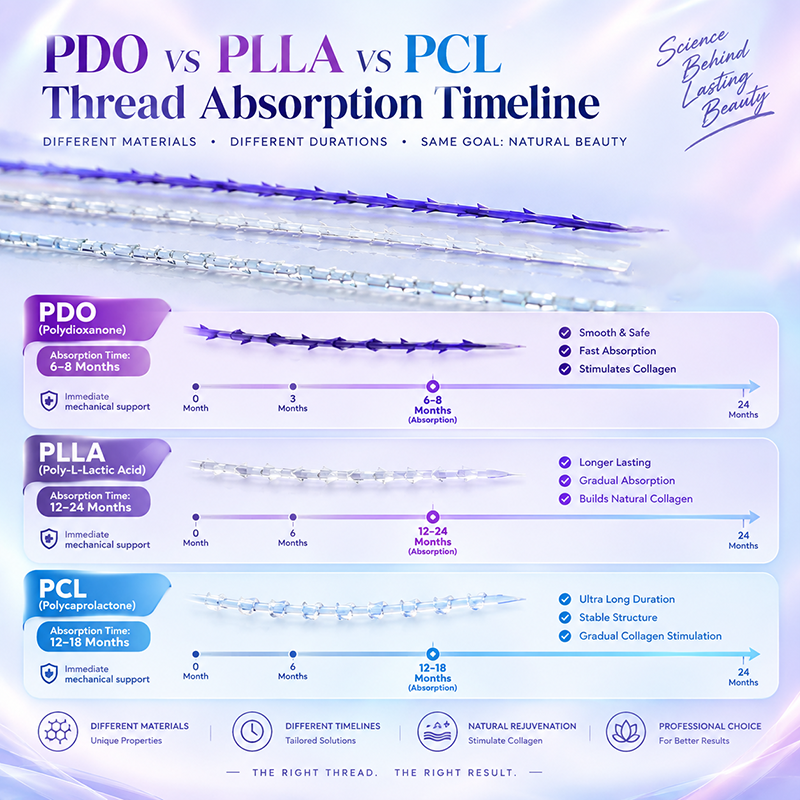
PDO (Polydioxanone)
PDO is the oldest and most widely used thread lifting material, with a 40-year history in surgical sutures before its aesthetic adoption. Absorbed in 3-6 months, PDO provides moderate collagen stimulation with average flexibility. It is the entry-level thread material: accessible price point, broad practitioner familiarity, and results that last 6–9 months. Available in the widest range of designs — mono, screw, cog (3D/4D/6D), fishbone/cones cog, multi, mesh, double needle. Gauge range 18G–30G depending on design. See: PDO Threads: The Complete Guide.
PCL (Polycaprolactone)
PCL is the longest-lasting absorbable thread material. Absorbed in more than 2 years (full biodegradation 16–24 months), PCL delivers sustained bio-stimulation — a gentler but longer signal than PLLA — with high elasticity and no patient discomfort. Results last 18–24 months. PCL is the premium tier of absorbable thread lifting: mono, cog 3D/4D/6D, cones cog, mesh and multi designs; gauge range 18G–27G depending on design. See: PCL Thread Lift: Long-Lasting Collagen.
PLLA (Poly-L-Lactic Acid)
PLLA produces the strongest and longest-term regenerative response of the three materials, through potent fibroblast activation. Absorbed in 2 years or more (full biodegradation 14–18 months), PLLA breaks down into harmless by-products — lactate, glucose, CO₂ and water. Results last 18–24 months and beyond, with a slower build-up. The trade-off is lower elasticity (can feel slightly firmer post-placement) and the strongest stimulation response, which may cause more initial inflammation in thin-skinned patients. Shipped nitrogen-packed for oxidation prevention. Available in mono, cog, nose thread and eye thread designs. See: the PLLA collection at /collections/plla--thread.
Complete Specification Comparison: PDO vs PLLA vs PCL
Data sourced from the Auro Thread Product Catalog and the website specifications at aurothread.com/collections/pdo-plla-pcl-thread.
| Parameter | PDO | PCL | PLLA |
|---|---|---|---|
| Full name | Polydioxanone | Polycaprolactone | Poly-L-Lactic Acid |
| Absorption time | 3-6 months | more than 2 years | 2 years or more |
| Biodegradation period (catalog) | 6–8 months | 16–24 months | 14–18 months |
| Effect duration | 6–9 months | 12–18 months (up to 24) | 18–24 months |
| Collagen stimulation | Moderate | Sustained bio-stimulation | Strong, long-term regeneration |
| Flexibility (catalog) | Average | High | Low |
| Discomfort (catalog) | Slight | No discomfort | Strong (can be noticeable) |
| Safety (catalog) | High | High | High |
Collagen Stimulation: How Each Material Works
All three materials trigger the same basic biological cascade: the thread acts as a foreign body; the body's repair system deposits new collagen around it. But the intensity, duration and tissue response differ by material:
- PDO: Moderate stimulus, concentrated in the first 4–6 months while the polymer hydrolizes. Collagen remodeling continues after absorption, sustaining results to ~6–9 months total. Best suited to skin quality, fine lines and mild structural support.
- PCL: Sustained bio-stimulation — a gentler but constant signal for 12–18 months. The polymer's high flexibility means fibroblast activation distributes more evenly through surrounding tissue. Total collagen effect supports visible results for 18–24 months. Best for practitioners who want a long single-session result.
- PLLA: The strongest bio-stimulator of the three. PLLA provokes intense fibroblast recruitment and collagen I/III synthesis, producing the deepest and most durable regeneration — well suited to patients with advanced skin aging where deep collagen rebuilding, not just lifting, is the goal. The stronger stimulus also means more post-treatment swelling in some patients.
For the science behind neocollagenesis and the collagen cascade, see Collagen Threads: How They Work.
Clinical Indications by Material
| Indication | Preferred Material | Reasoning |
|---|---|---|
| Fine lines, skin quality | PDO mono (26G–30G) | Superficial, accessible, short treatment cycle |
| First-time thread lift patient | PDO | Entry price, short commitment, easy to re-assess |
| Jawline / V-line (mild laxity) | PDO cog or PCL cog 3D/4D | PDO for subtle; PCL for longer-lasting structural hold |
| Jawline / V-line (moderate laxity) | PCL Cog 6D or Cones Cog | Maximum anchoring, sustained 18–24 month support |
| Nasolabial folds (deep) | PCL Mesh 19G | Broad-area support and long collagen remodeling window |
| Full-face collagen regeneration | PLLA mono / cog | Strongest regenerative signal, 18–24 month result |
| Nose augmentation | PCL Tornado screw or PCL Nose Thread (L Cannula 19G) | Localized volume + longer duration than PDO |
| Eye / peri-orbital rejuvenation | PDO Eye Thread (30G W Cannula) or PCL Eye Thread | Ultra-fine gauge, blunt cannula, minimal trauma |
Gauge and Design Range by Material
All three materials are available in multiple design configurations from AuroThread — the exact gauge and suture length depend on the specific SKU. Below are typical catalog ranges. Always confirm the exact specification per product listing before ordering.
| Material | Design Family | Gauge Range | Suture Length Range |
|---|---|---|---|
| PDO | Mono, Screw, Tornado, Cog 3D/4D/6D, Cones Cog, Multi, Eye, Nose | 18G–30G | 13–400 mm |
| PCL | Mono, Screw, Cog 3D/4D/6D, Cones Cog, Mesh, Multi, Eye, Nose | 18G–27G | 25–100 mm |
| PLLA | Mono, Cog, Nose Thread, Eye Thread | 18G–29G | 25–100 mm |
Selection Framework: When to Choose Each Material
Choose PDO when:
- Patient is thread-naive or budget-sensitive.
- Goal is skin quality, fine lines or mild collagen stimulation — not structural lift.
- Short treatment cycle is preferred (re-assessment or bridging protocol).
- Wide design range needed (PDO has the broadest SKU family).
Choose PCL when:
- Patient wants the longest single-treatment result (18–24 months).
- Indication requires deep anchoring — jawline, mid-face, nasolabial folds.
- Patient comfort is critical; high elasticity = no post-placement stiffness.
- Clinic is building a premium, long-effect service tier.
Choose PLLA when:
- Goal is maximal, deep collagen regeneration — not immediate mechanical lift.
- Patient has advanced skin aging, significant dermal volume loss.
- Patient can tolerate stronger stimulation and possible initial firmness/swelling.
- Protocol is staged across multiple sessions for progressive bio-remodeling.
The two-material deep dives: PCL vs PDO Threads: Key Differences · PDO vs PCL: What Is the Difference? · PCL Thread Lift: Long-Lasting Collagen · Collagen Threads: How They Work · Permanent Thread Lift: Pros & Cons.
AuroThread Product Range
AuroThread manufactures the complete PDO, PLLA and PCL range in-house, with factory-direct wholesale pricing, OEM/ODM, custom packaging, and evaluation samples for qualified clinics and distributors. Browse the collections:
- PDO Thread collection — full range including Mono, Screw, Cog 3D/4D/6D, Cones Cog, Multi, Eye, Nose threads
- PCL Thread collection — Mono, Cog 3D/4D/6D, Cones Cog, Mesh, Tornado, Multi, Eye, Nose threads
- PLLA Thread collection — Mono, Cog, Nose Thread, Eye Thread
- PDO / PLLA / PCL combined collection — browse all three families in one view
Frequently Asked Questions
What is the difference between PDO, PLLA and PCL threads?
All three are absorbable, biocompatible lifting threads, but they differ in absorption speed, effect duration and collagen stimulation intensity. PDO absorbs in 3-6 months (effect 6–9 months, moderate collagen); PCL in 12–18 months (effect 18–24 months, sustained bio-stimulation, high elasticity); PLLA in 12–18 months (effect 18–24 months, strong regeneration, low elasticity, nitrogen-packed storage).
Which thread lasts longest: PDO, PCL or PLLA?
PCL has the longest biodegradation period (16–24 months) and PCL/PLLA both deliver 18–24 month visible results. PLLA is the strongest collagen stimulator but both PCL and PLLA outlast PDO by approximately 2–3× for effect duration. PDO results typically last 6–9 months.
Can PDO, PCL and PLLA threads be used together?
Yes — multi-material protocols are common. A typical full-face approach might use PCL cog threads for structural lifting (longer anchoring), PDO mono threads for superficial collagen and skin quality, and PLLA threads in a staged series for deep bio-regeneration. Treatment planning must be carried out by a licensed practitioner.
Do PLLA threads hurt more than PDO or PCL?
The AuroThread catalog rates PLLA as having the strongest discomfort potential of the three, PDO as slight, and PCL as no discomfort. PLLA's lower elasticity and stronger bio-stimulation can cause initial firmness in the treated area. Under proper local anesthesia, patient experience is generally manageable; discuss candidacy and post-care with a licensed practitioner.
Where can I buy PDO, PLLA and PCL threads wholesale?
AuroThread manufactures the complete range — PDO, PCL and PLLA — in all major design types, factory-direct at wholesale pricing. OEM/private-label and evaluation samples available. Browse all three families or contact our wholesale team for custom configurations.
Related Products

Classic PDO mono thread for skin tightening, fine lines and collagen bio-stimulation. USP 6-0, EO sterile.
View Product
Long-effect anti-aging PCL cog 6D thread for structural lift with up to 18–24 months of visible results.
View ProductEducational content only — not medical advice. Results vary by individual. Thread placement must be performed by licensed practitioners. © 2026 Auro Technology Limited.