
PDO Screw Threads: Uses & Technique
PDO screw threads are absorbable threads formed into a spiral or coil shape. The coil structure compresses surrounding tissue and restores volume — making screw threads the standard choice for small-area volume restoration in the lips, nasolabial folds, and overall face, where neither smooth mono threads (no volume effect) nor cog threads (too aggressive for delicate zones) are optimal. The flagship design in this family is the Tornado Screw Thread: a double-spiral structure combining two screw-shaped strands in one needle, delivering approximately twice the collagen stimulation of a standard single-helix screw.
For the full thread type overview, see our PDO Threads: The Complete Guide.
On this page:
- What are screw threads?
- How the coil restores volume
- Tornado Screw Thread — the double-spiral design
- Best treatment areas by indication
- Gauges, lengths & specifications
- Insertion technique
- Screw vs mono vs cog: choosing the right design
- Wholesale & OEM supply
- Frequently asked questions
What Are Screw Threads?
Screw threads are PDO monofilament threads wound into a tight spiral around a needle shaft. The coil increases the thread's effective surface area compared to a smooth mono filament, creating a spring-like structure that physically compresses and supports tissue when implanted subcutaneously. They absorb in approximately 6 months like all PDO, with volume-support results typically lasting 9–12 months.
Screw threads sit between mono and cog in the PDO design hierarchy:
- Mono threads — smooth, collagen stimulation only, no volume effect
- Screw threads — coiled, volume restoration + collagen, moderate support
- Cog threads — barbed, mechanical structural lifting, strongest anchoring
For the material science behind PDO, see Polydioxanone Threads Explained.
How the Coil Restores Volume
- Insertion — the coiled thread is placed in the subcutaneous layer through a fine needle (26G or 27G). The coil remains compressed along the needle shaft during insertion.
- Deployment — once the needle is withdrawn, the coil expands slightly against surrounding tissue, creating immediate gentle compression and mechanical volume support.
- Collagen scaffold phase (8–12 weeks) — fibroblasts deposit Type I/III collagen around the coil surface. The increased surface area of a screw design (vs. smooth mono) generates a proportionally larger collagen scaffold.
- Absorption (4–6 months) — PDO hydrolyses into water and CO₂. The collagen scaffold it built persists for 9–12 months, sustaining the volume effect after absorption.
Unlike cog threads, screw threads do not pull tissue — they push and support it from within. That makes them the preferred design for areas where an aggressive mechanical lift would look unnatural, such as the lips, perioral zone, and nasolabial folds.
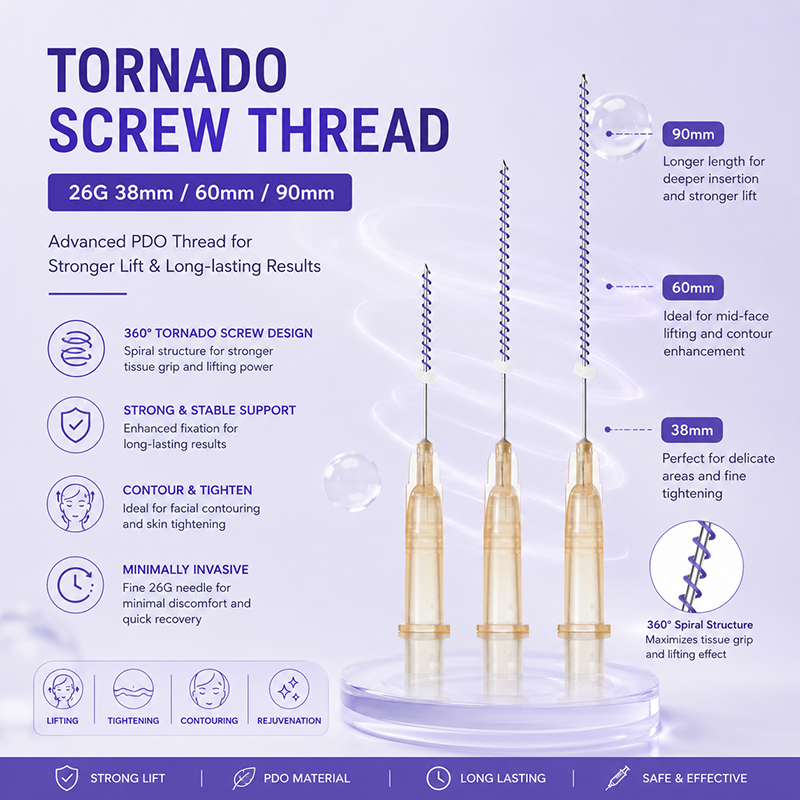
Tornado Screw Thread — The Double-Spiral Design
The Tornado Screw Thread is the flagship screw-design product in the AuroThread range. Unlike a standard single-helix screw thread, the Tornado combines two screw-shaped PDO strands twisted inside one needle — a double-spiral structure that:
- Holds skin tissue more firmly than a single strand
- Stimulates approximately twice the collagen response of a standard screw thread
- Provides immediate visible volume support alongside progressive biostimulatory results
The Tornado is available in PDO, PLLA, or PCL material — allowing clinics to match the thread to the treatment cycle: PDO for standard results, PLLA for longer collagen stimulation, PCL for the longest-lasting lift. CE/RoHS compliant, EO sterile.
Best Treatment Areas by Indication
| Indication | Design Recommendation | Gauge / Length |
|---|---|---|
| Lip contour definition | Tornado Screw (double-spiral) | 27G · 38 mm |
| Smoker's lines (perioral rhytides) | Tornado Screw (double-spiral) | 26G or 27G · 38 mm |
| Nasolabial folds | Tornado Screw or single screw | 26G · 60/90 mm |
| Overall face volume restoration | Tornado Screw | 26G · 60/90 mm |
| Nose augmentation / tip | Single screw or double screw | 26G · 38/60 mm |
| Hollow cheeks | Double screw / Multi Thread | 26G · 60 mm |
Note: the nose and tear-trough zones require advanced training and careful depth assessment; screw threads in these areas should be reserved for experienced practitioners.
Gauges, Lengths & Technical Specifications
The following specifications are sourced directly from the Tornado Screw Thread product page:
| Parameter | Specification |
|---|---|
| Type | Tornado Screw Thread (double-spiral) |
| Material | PDO / PCL / PLLA — choose to match treatment cycle |
| Structure | Double spiral — 2 screw-shaped sutures in one needle |
| Available gauges & lengths | 26G: 38 mm / 60 mm / 90 mm | 27G: 38 mm / 50 mm / 60 mm / 90 mm |
| Applications | Lip contour, smoker's lines, nasolabial folds, face lifting |
| Sterilization | EO sterile |
| Certification | CE / RoHS compliant |
| OEM / Customization | Custom length, gauge, packaging; OEM/ODM, private label available |
Insertion Technique — General Overview
The following is educational only. Practitioners must follow their training and product IFU.
Depth and Placement Layer
- Screw threads are placed in the subcutaneous (subdermal) plane — below the dermis, above the muscle fascia. Incorrect depth (intradermal or submuscular) is the most common technique error.
- For lip and perioral work, the plane is shallower — just below the dermis of the lip border or vermilion.
Thread Count per Session
- Lip contour: 2–4 threads (1–2 per lip border)
- Nasolabial folds: 2–4 threads per fold, depending on depth
- Full face volume: 6–12 threads across multiple zones
Combining With Other Thread Types
Screw threads are frequently combined with cog threads in a single session: cog threads first to establish structural lift at the SMAS plane, followed by screw threads for volume restoration in folds and perioral zones, and mono threads layered superficially for skin quality. This multi-layer protocol addresses all three clinical targets — lift, volume, and texture — in one treatment.
Screw vs. Mono vs. Cog: Choosing the Right Design
| Factor | Screw / Tornado | Mono | Cog |
|---|---|---|---|
| Primary role | Volume restoration | Collagen bio-stimulation | Mechanical lifting |
| Gauge | 26G–27G | 26G–30G | 18G–23G |
| Duration | 9–12 months | 6–9 months effect; 12–18m collagen | 12–18+ months |
| Key indication | Lips, folds, hollows | Fine lines, skin quality | Jawline, cheek, brow lift |
| Complication risk | Low — no barbs | Lowest | Higher — technique-sensitive |
The complete decision framework is in PDO Thread Types: Mono vs Cog vs Screw. For the double-spiral variant, see Double Screw Threads Guide and Tornado Screw Thread: Technique.
Wholesale & OEM Supply
AuroThread manufactures Tornado Screw and the full screw thread range as a CE-certified factory under ISO 13485 QMS. Factory-direct wholesale pricing, OEM/ODM customization, private-label packaging, and free evaluation samples are available for qualified wholesale clients.
| Supply Option | Details |
|---|---|
| OEM / Private Label | Custom length, gauge, packaging; OEM/ODM and private label available |
| Material options | PDO (standard) · PCL (longer duration) · PLLA (extended collagen stimulation) |
| Free Sample | Available for qualified wholesale buyers on request |
This guide is educational and not medical advice; screw thread placement must be performed by licensed practitioners.
Frequently Asked Questions
What are screw threads used for?
Volume restoration in small areas — lip contour, smoker's lines, nasolabial folds, nose, and hollow cheeks — where the coil compresses and supports tissue from within. The Tornado double-spiral variant extends the effect to overall face lifting.
What is the Tornado Screw Thread?
The Tornado Screw Thread is a double-spiral PDO thread — two screw-shaped strands twisted inside one needle. This design delivers approximately 2× the collagen stimulation of a standard single-helix screw thread. Available in 26G (38/60/90 mm) and 27G (38/50/60/90 mm) in PDO, PLLA, or PCL.
How long do screw thread results last?
Typically 9–12 months for standard screw designs. The Tornado double-spiral extends this through its stronger collagen scaffold. PDO material absorbs in ~3-6 months; collagen persistence supports the volume effect beyond absorption. Maintenance sessions at 9–12 month intervals are standard.
Do screw threads lift or add volume?
They primarily restore volume — the coil compresses and supports tissue. For mechanical structural lifting (jawline, brow, cheek), cog threads are the correct design. Screw threads are typically combined with cog threads in a full-face protocol.
Can I buy Tornado screw threads wholesale?
Yes — AuroThread supplies the Tornado Screw Thread at factory-direct wholesale pricing in PDO, PLLA, and PCL. OEM private-label and custom gauge/length available. Free samples for qualified buyers. See the full PDO collection or contact our wholesale team.
Related Products

2× collagen vs standard screw — lip contour, smoker's lines, nasolabial folds
View Product
Precise lip border definition and perioral fine line treatment
View ProductEducational content only — not medical advice. Results vary by individual. © 2026 Auro Technology Limited.