
What Are PDO Threads
PDO threads are ultra-fine, absorbable medical sutures made from polydioxanone — the same biocompatible polymer used in surgical sutures since the 1980s. In aesthetic medicine, they are inserted beneath the skin to lift lax tissue, smooth wrinkles, and stimulate natural collagen production. Because the threads dissolve completely within 4–6 months while the collagen they trigger lasts longer, PDO threading has become one of the most popular non-surgical skin-tightening treatments worldwide.
On this page:
- PDO threads are absorbable, not implants
- The science of PDO threads, in brief
- How PDO threads work: two mechanisms
- PDO thread types at a glance
- A brief history: from surgery to aesthetics
- What PDO threads are used for
- PDO threads vs. other treatments
- Are PDO threads safe?
- How to choose and buy PDO threads
- Frequently asked questions
PDO Threads Are Absorbable , Not Implants
The most important fact to understand: PDO threads are not permanent implants. They are absorbable sutures that provide temporary mechanical support while the body builds its own collagen around them. Key material facts:
- Material: polydioxanone, a colorless, biocompatible synthetic polymer with a 40-year history in absorbable surgery.
- Diameter: typically 26G to 30G — finer than most surgical sutures, engineered for the delicate facial tissues.
- Absorption: fully hydrolyzed and cleared by the body within 4–6 months, leaving no permanent foreign material.
- Safety standard: USP Class VI biocompatibility — the same implant-grade standard used in cardiac surgery.
This temporary-but-effective profile is exactly why PDO threads suit patients who want visible results without permanent changes — see what does PDO mean for the material science behind the polymer. The same surgical-grade standards apply across our PDO surgical suture collection.
The Science of PDO Threads, in Brief
Competing guides cover the science superficially. Here is what actually matters:
- Mechanism: PDO threads create both immediate mechanical support and a sustained foreign-body response that recruits fibroblasts — the cells that produce collagen I and III.
- Kinetics: collagen deposition peaks at 3–6 months, which is why results improve progressively after placement.
- Regulatory classification: PDO absorbable sutures are classified as medical devices in most markets; USP Class VI biocompatibility is the material benchmark referenced by regulators.
The full chemistry — degradation mechanisms, strength retention, and how PDO compares molecule-by-molecule with PLLA and PCL — is covered in What Does PDO Mean?
How PDO Threads Work: Two Mechanisms at Once
When a PDO thread is placed under the skin, it works in two complementary ways:
- Immediate mechanical support — the thread physically holds and repositions lax tissue from day one.
- Long-term collagen stimulation — fibroblasts deposit new collagen I and III around the thread channel, peaking at 3–6 months.
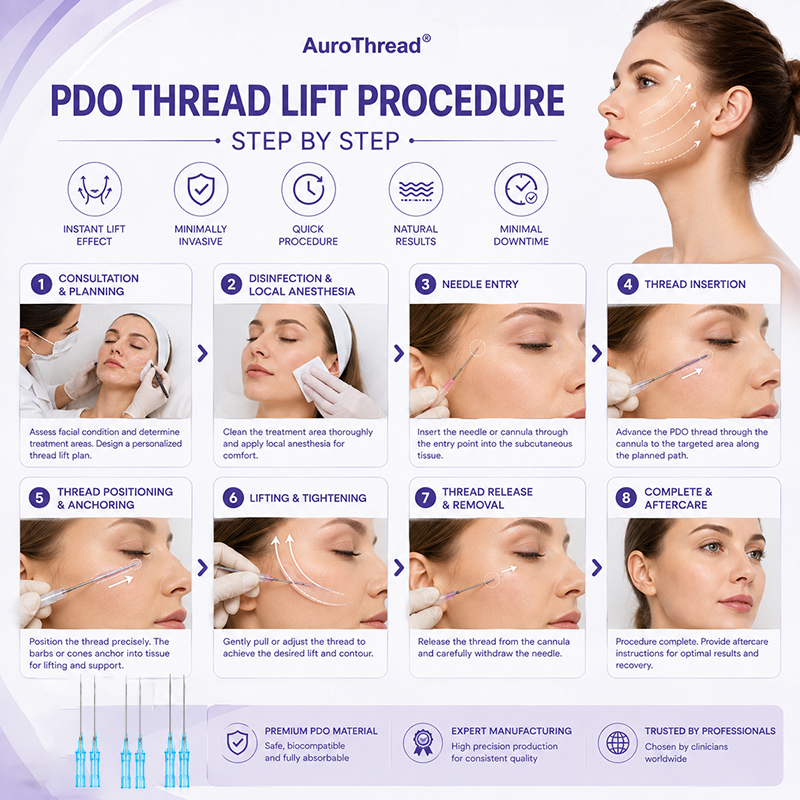
The practical consequence: the lift you see immediately is only part of the story — the best results appear months later as collagen builds. That timeline is what the procedure itself looks like, covered in What Is a PDO Thread Lift?
PDO Thread Types at a Glance
PDO threads are a family of designs, each with a different clinical role:
- Mono (smooth) threads — collagen stimulation, skin tightening, fine lines; the standard entry-level choice.
- Cog (barbed) threads — barbs anchor into tissue, delivering true mechanical lifting for jawlines and brows.
- Screw and tornado threads — coil designs that compress tissue to restore volume in small areas like the nose and lips.
- Mesh and multi-needle threads — broader support and faster full-face protocols.
The full design map — gauge selection, needle matching, area mapping — is in our thread type comparison.
A Brief History: From Surgery to Aesthetics
Polydioxanone was introduced in the early 1980s as an absorbable suture for cardiovascular and general surgery — valued for its strength, predictable absorption, and tissue compatibility. The leap into aesthetics happened when practitioners noticed that sutures left beneath the skin not only closed tissue but stimulated collagen around the suture channel. By the 2000s, dedicated PDO thread products with needles and cannulas were developed for facial rejuvenation, and the technique spread rapidly across Asia, Europe, and the Americas. Today, PDO is the most widely used absorbable thread material worldwide — the entry point of the thread market, with PLLA and PCL as longer-lasting premium alternatives.
What PDO Threads Are Used For
- Skin tightening — cheeks, jawline, neck, and mid-face laxity.
- Fine line and wrinkle smoothing — nasolabial folds, marionette lines, forehead lines.
- Non-surgical lifting — brow, jowl, and chin definition with cog threads.
- Volume restoration — small-area support with screw/tornado threads (nose, lips).
- Preventive maintenance — collagen stimulation for younger clients before significant laxity develops.
Every application is procedure-driven; the treatment itself is explained in What Is a PDO Thread Lift?, and the concept behind the broader technique in What Is Threading?
PDO Threads vs. Other Skin-Tightening Treatments
| Treatment | Mechanism | Lift Strength | Downtime |
|---|---|---|---|
| PDO Threads | Mechanical lift + collagen | Mild-moderate | Minimal |
| Ultherapy (HIFU) | Heat-triggered collagen | Mild | None |
| RF Microneedling | RF heat + micro-injury | Mild | 1-2 days |
| Dermal Fillers | Volume replacement | Volume, not lift | Minimal |
| Surgical Facelift | Tissue repositioning | Strong | 1-2 weeks |
The key distinction: PDO threads are the only option that combines mechanical lift with sustained collagen stimulation — which is why they remain the entry point of the absorbable-thread market.
Are PDO Threads Safe?
PDO has a strong safety record: a 40-year history as an absorbable suture, USP Class VI material certification, and a complication profile that is mostly mild and technique-related when placed by trained practitioners. As a manufacturer, we control three quality variables that directly affect safety and results — material grade, EO sterilization validation, and batch traceability — all documented for every product we ship, with CE certificates, sterilization reports, and biocompatibility test data available to support your local registration. A full evidence-based review of risks is in our complications & risks guide.
How to Choose and Buy PDO Threads
For clinics and distributors, five criteria decide product quality:
- Material certificate — request USP Class VI or equivalent biocompatibility documentation.
- Sterilization validation — EO process with per-batch biological indicators and residual testing.
- Batch traceability — lot numbers on every box linking to production and QC records.
- Range completeness — a single supplier should cover mono, screw, multi, cog, and cone cog to keep protocols flexible.
- Consistent supply — stable lead times and documented expiry dating avoid clinic disruptions.
Our supplier selection guide turns this into a practical checklist. The full range — PDO Mono (26G–30G), Screw, Multi, Cog, and Cone Cog (18G W/L) — is available in our PDO thread collection, with wholesale pricing and OEM/private-label options from 50 units.
Frequently Asked Questions
Are PDO threads permanent?
No — PDO threads are fully absorbable and dissolve in 3-6 months. The collagen they stimulate persists, which is why results outlast the threads.
What are PDO threads made of?
Polydioxanone — a biocompatible, absorbable synthetic polymer with a 40-year history in surgical sutures and USP Class VI certification.
What are the benefits of PDO threads?
Non-surgical lift, minimal downtime, natural collagen regeneration, versatility across treatment areas, and a high safety profile.
Are PDO threads FDA approved?
Polydioxanone absorbable sutures are classified as medical devices and regulated in most markets; USP Class VI biocompatibility is the widely referenced material benchmark. Verify your supplier's certificates.
How much do PDO threads cost wholesale?
Wholesale pricing depends on thread type, gauge, needle configuration, and volume. Manufacturer-direct sourcing reduces material cost significantly — request a quote.
Can I buy PDO threads in bulk?
Yes — AuroThread supplies the full PDO thread range in bulk from 50 units, with private label and OEM options. Browse the collection or contact our wholesale team.
Written by the AuroThread R&D Team — Educational content only; not medical advice. Results vary by individual. © 2026 Auro Technology Limited.