
PDO Cog Threads: How They Lift
PDO cog threads are absorbable threads with tiny barbs (cogs) spirally placed along their length, designed for mechanical lifting. Unlike smooth mono threads which only stimulate collagen, cog threads anchor into tissue with their barbs and physically hold the lifted position. AuroThread supplies three main cog configurations — Cog 3D, Cog 4D, and Cog 6D — each defined by the number of directions in which the 360°-spiral barbs fix and support skin tissue, delivering progressively stronger anchoring and longer-lasting results.
For the full thread type overview, see our PDO Threads: The Complete Guide.
On this page:
- What are cog threads?
- How the barbs lift tissue
- Cog 3D vs 4D vs 6D — what the dimensions mean
- Complete model specifications
- Best treatment areas
- How to choose the right cog configuration
- Cog vs mono vs screw: clinical decision table
- Wholesale & OEM supply
- Frequently asked questions
What Are Cog Threads?
Cog threads are monofilament PDO threads with small barbs (cogs) cut into the surface. The barbs face a controlled direction: they lie flat during insertion, then spring out to grip surrounding tissue when the thread is pulled back — like a row of miniature anchors. This one-way grip is what makes mechanical lifting possible without incisions.
From the AuroThread catalog: "It is premium lifting thread made of PDO which is absorbed after proliferating collagen by stimulating fibroblast. Any of you can experience overall face contouring, skin elasticity. It brings natural and dramatic effect to face and body after simple and safe treatment. The superior quality of the ultra-thin wall Needle allows the treatment easy, atraumatic and painless."
Cog threads are available with three needle delivery options: Sharp Needle, L Cannula (blunt, single-exit), and W Cannula (blunt, wider-bore) — in PDO, PCL, and PLLA material.
How the Barbs Lift Tissue
- Insertion — the thread slides in with the barbs folded flat against the shaft. The blunt cannula option minimises trauma; the sharp needle allows direct precise placement.
- Anchoring — the practitioner pulls the thread; the 360°-spiral barbs spring out and anchor into the surrounding subcutaneous tissue in their respective directions (3, 4, or 6 directions depending on the configuration).
- Lift — the anchored barbs hold the tissue in its lifted position, creating an immediate mechanical lift visible on the day of treatment.
- Collagen phase — over 3–6 months, the body deposits new collagen around the thread, reinforcing the lift and sustaining the result after the PDO absorbs (3–6 months).
This mechanical anchoring is the defining difference from smooth mono threads. See Smooth PDO Threads: What They Do for the comparison.
Cog 3D vs 4D vs 6D — What the Dimensions Mean
The 3D / 4D / 6D designation describes the number of directions in which the 360°-spiral barbs conceive, fix, and support the skin tissue. More directions = more anchoring points per unit length = stronger hold and longer-lasting lift.
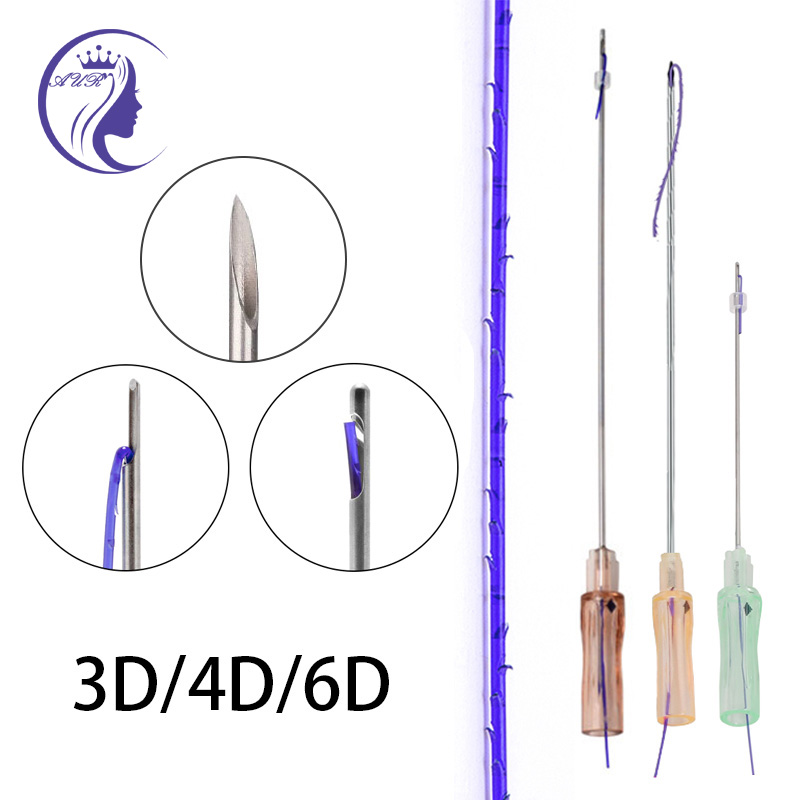
| Configuration | Anchoring Directions | Anchoring Strength | Needle Types Available | Thread Thickness |
|---|---|---|---|---|
| Cog 3D | 3 directions | Moderate — long-term, smooth anchoring | Sharp Needle, L Cannula | USP-2 |
| Cog 4D | 4 directions | Strong — better lifting effect than 3D | Sharp Needle, L Cannula, W Cannula | USP-2 |
| Bidirectional Cog 4D | 4 directions (bi-directional) | Strong — dual-direction locking | Sharp Needle, L Cannula, W Cannula | USP-2 |
| Cog 6D | 6 directions | Maximum — strongest anchoring in the range | L Cannula, W Cannula only | USP-1 (thickest) |
Important: The "3D/4D/6D" designation refers to the number of tissue-anchoring directions from the 360°-spiral barb arrangement — not a barb-angle measurement. The Cog 6D is the only configuration with USP-1 thread and is delivered exclusively via blunt cannula, reflecting its use in deeper tissue planes.
Complete Model Specifications (from Auro Thread PDO Catalog)
All specifications are sourced directly from the printed Auro Thread PDO Catalog. All configurations are available in PDO, PCL, and PLLA.
Cog 3D — USP-2
| Needle Type | Gauge | Needle Length | Suture Length |
|---|---|---|---|
| Sharp Needle | 23G | 60 mm | 120 mm |
| Sharp Needle | 23G | 90 mm | 160 mm |
| Sharp Needle | 19G | 100 mm | 160 mm |
| L Cannula | 19G | 100 mm | 160 mm |
| L Cannula | 21G | 100 mm | 120 mm |
| L Cannula | 21G | 60 mm | 160 mm |
Cog 4D — USP-2
| Needle Type | Gauge | Needle Length | Suture Length |
|---|---|---|---|
| Sharp Needle | 23G | 60 mm | 120 mm |
| Sharp Needle | 23G | 90 mm | 150 mm |
| Sharp Needle | 19G | 100 mm | 160 mm |
| L Cannula | 19G | 100 mm | 160 mm |
| L Cannula | 21G | 100 mm | 160 mm |
| L Cannula | 21G | 60 mm | 120 mm |
| W Cannula | 19G | 100 mm | 160 mm |
| W Cannula | 21G | 90 mm | 150 mm |
Bidirectional Cog 4D — USP-2
| Needle Type | Gauge | Needle Length | Suture Length |
|---|---|---|---|
| Sharp Needle | 19G | 100 mm | 160 mm |
| Sharp Needle | 21G | 90 mm | 150 mm |
| L Cannula | 19G | 100 mm | 160 mm |
| L Cannula | 21G | 90 mm | 150 mm |
| W Cannula | 19G | 100 mm | 160 mm |
| W Cannula | 21G | 90 mm | 150 mm |
Cog 6D — USP-1 (thickest) · Blunt Cannula Only
| Needle Type | Gauge | Needle Length | Suture Length |
|---|---|---|---|
| L Cannula | 19G | 100 mm | 160 mm |
| W Cannula | 19G | 100 mm | 160 mm |
Best Treatment Areas
From the AuroThread catalog, the Cog 3D/4D/6D range is indicated for:
Face
- Forehead Wrinkles
- Frown Line (Glabella)
- Crow's Feet
- Lacrimal Sulcus
- Wrinkled Nose
- Nasolabial Folds
- Cheeks Lifting
- Lip Wrinkles
- Neck Lifting / Neck Wrinkles
Body
- Chest
- Hip
- Leg
How to Choose the Right Cog Configuration
| Clinical Need | Recommended Config | Example Model |
|---|---|---|
| Moderate lift, mid-face, first cog treatment | Cog 3D | 23G 60/90 mm Sharp Needle, or 21G L Cannula |
| Stronger lift, jawline, brow, forehead | Cog 4D | 23G Sharp Needle, or 19G L/W Cannula 100 mm |
| Multi-point suspension, dual-direction anchoring | Bidirectional Cog 4D | 19G or 21G, L/W Cannula or Sharp Needle |
| Maximum anchoring, deep tissue, jowl/neck/body | Cog 6D | 19G 100 mm L or W Cannula only (USP-1) |
- Anchoring strength: 6D > Bidirectional 4D > 4D > 3D
- Sharp needle vs. cannula: Sharp for direct precise placement; L/W cannula for reduced trauma. Cog 6D is cannula-only.
- Material: PDO (3–6 month absorption) · PLLA (14–18 months) · PCL (16–24 months) — match to desired duration.
- Gauge: 19G for deeper planes and body; 21G/23G for face zones.
Cog vs. Mono vs. Screw: Clinical Decision Table
| Factor | Cog (3D/4D/6D) | Mono Thread | Screw / Tornado |
|---|---|---|---|
| Primary role | Mechanical lifting | Collagen bio-stimulation | Volume restoration |
| Gauge range | 19G–23G | 26G–30G | 26G–27G |
| Immediate lift | Yes — same-day visible lift | No — gradual collagen over 8–12 weeks | Partial — compression/volume support |
| Ideal indication | Jowl, cheek, brow, neck, body | Fine lines, skin quality, periorbital | Folds, lips, smoker's lines |
| Risk profile | Higher — technique-sensitive | Lowest | Low |
See PDO Thread Types: Mono vs Cog vs Screw and Barbed Threads: Complete Guide for full comparisons.
This guide is educational and not medical advice; cog thread placement must be performed by licensed practitioners.
Wholesale & OEM Supply
AuroThread manufactures the full cog range — 3D, 4D, Bidirectional 4D, and 6D — in PDO, PCL, and PLLA, under ISO 13485 GMP. All configurations available in sharp needle, L cannula, and W cannula (6D in cannula only). Factory-direct wholesale, OEM/ODM, custom packaging, and free evaluation samples for qualified wholesale clients.
Frequently Asked Questions
What does 3D, 4D, and 6D mean in cog threads?
The number refers to the number of directions in which the 360°-spiral barbs fix and support the skin tissue — sourced directly from the Auro Thread PDO Catalog. Cog 3D anchors in 3 directions, 4D in 4 directions, and 6D in 6 directions, giving progressively stronger hold. This is not a barb-angle measurement.
Which cog configuration is the strongest?
Cog 6D — 6 tissue-anchoring directions, USP-1 thread (thickest in the range), available in 19G 100 mm L or W cannula only. It is designed for maximum anchoring in jowl, neck, and body contouring applications where the deepest, strongest hold is required.
How long do cog thread results last?
PDO cog threads absorb in 3–6 months; the collagen they stimulate sustains the result beyond absorption. With PDO material: 3–6 months absorption; with PLLA: 14–18 months; with PCL: 16–24 months. The 6D configuration provides the longest mechanical anchoring of all cog designs. Maintenance sessions extend and sustain results.
What is the difference between L Cannula and W Cannula?
Both are blunt-tip cannulas that reduce insertion trauma. The L Cannula has a single exit port; the W Cannula has a wider bore. The W Cannula is available for Cog 4D, Bidirectional 4D, and Cog 6D — designed for practitioners who prefer wider-bore access for deeper tissue-plane work. Sharp Needle delivery is available for Cog 3D and 4D (not 6D).
Can I buy cog threads wholesale?
Yes — AuroThread supplies Cog 3D, 4D, Bidirectional 4D, and 6D at factory-direct wholesale prices in PDO, PCL, and PLLA. OEM private-label and custom packaging available. See the Cog product page, the full PDO collection, or contact our wholesale team.
Related Products

19G–23G · 60–160 mm suture · PDO/PCL/PLLA · Sharp Needle / L & W Cannula
View Product
Most effective lifting effect · long lasting · face, arm & body contouring
View ProductEducational content only — not medical advice. Results vary by individual. © 2026 Auro Technology Limited.