
what is threading
Thread lifting is a non-surgical procedure that uses absorbable threads to lift sagging facial tissue and stimulate collagen — the modern, minimally invasive middle ground between injectables and surgical facelifts. Fine medical-grade threads are placed beneath the skin, gently pulled to reposition tissue, and left to dissolve while the body builds its own collagen around them.
This guide covers the concept of thread lifting: how the lift actually works, how it compares with surgery, and its advantages and limitations. For the broader family of thread techniques, see What Is Threading?; for step-by-step procedure details, What Is a PDO Thread Lift?; and for the complete topic, PDO Threads: The Complete Guide. The threads themselves are covered in What Are PDO Threads?, and the material science in What Does PDO Mean?
On this page:
- How a thread lift works: the two-phase lift
- Thread lifting vs. surgical facelift
- Advantages of thread lifting
- Limitations and considerations
- Who should not have a thread lift
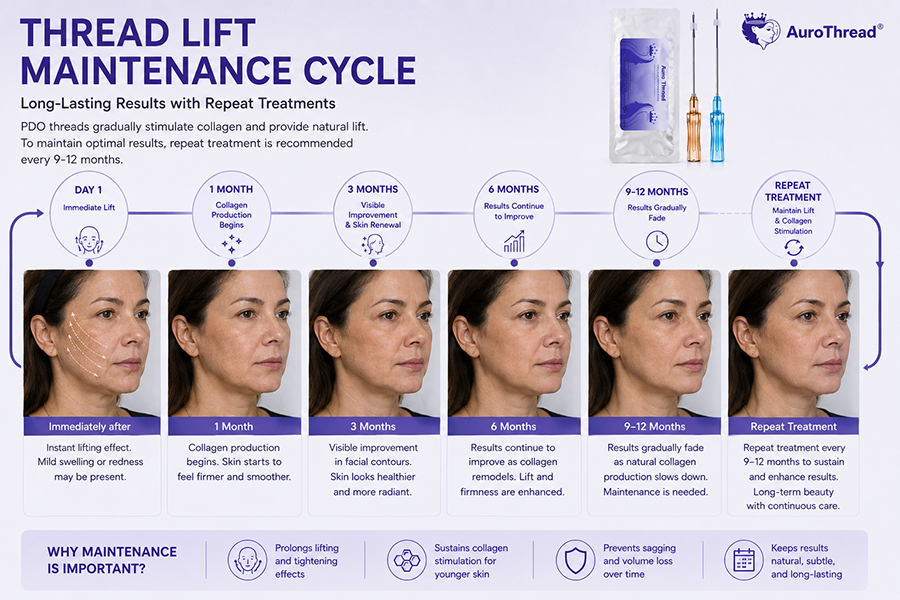
- Maintenance and repeat treatments
- Cost considerations
- Frequently asked questions
How a Thread Lift Works: The Two-Phase Lift
A thread lift achieves its effect through two mechanisms working in sequence:
- Mechanical phase (immediate): barbed (cog) threads anchor into tissue and physically hold the lifted position from day one. This is the "lift" part of the name.
- Biological phase (progressive): the body deposits new collagen around each thread over 3–6 months, firming skin and sustaining the lift after the threads dissolve.
The result: an immediate visible lift that improves over months, typically lasting 6–9 months for PDO threads (longer for PLLA and PCL materials).
Thread Lifting vs. Surgical Facelift
| Aspect | Thread Lift | Surgical Facelift |
|---|---|---|
| Anesthesia | Local | General or IV sedation |
| Downtime | Same-day return to work | 1-2 weeks |
| Result duration | 6-24 months (by material) | 5-10 years |
| Best for | Mild-to-moderate laxity | Advanced ptosis |
| Cost | $300-$1,500/session | $8,000-$25,000 |
Thread lifting is not a replacement for surgery — it addresses a different severity of laxity. The honest assessment: mild-to-moderate sagging responds well to threads; advanced ptosis requires surgical correction.
Advantages of Thread Lifting
- Non-surgical: no scalpel, no general anesthesia, no hospital stay.
- Minimal downtime: most patients return to work the same day.
- Natural results: works by stimulating the body's own collagen.
- Progressive improvement: results keep improving for 3–6 months.
- Recurring revenue for clinics: maintenance cycles every 9–12 months.
Limitations and Considerations
- Not permanent: results fade as the collagen scaffold remodels; maintenance is required.
- Candidacy matters: advanced laxity, very thin skin, or active skin conditions reduce suitability.
- Technique-dependent: outcomes and safety depend heavily on practitioner training and product quality — which is why we publish material and sterilization standards openly across our PDO surgical suture collection.
Who Should Not Have a Thread Lift
- Pregnancy and breastfeeding — avoid elective procedures.
- Active skin infections or inflammation in the treatment area.
- Allergy to polydioxanone or related polymers (rare but screened).
- Uncontrolled autoimmune or systemic disease — assessed case by case by the practitioner.
- Advanced ptosis — threads cannot replace surgical correction; over-promising damages both patient and clinic reputation.
- Unrealistic expectations — the single biggest driver of dissatisfaction.
Full clinical considerations are in our complications & risks guide.
Maintenance and Repeat Treatments
- Timing: most clinics schedule touch-ups at 9–12 months, before results fully fade.
- Volume: maintenance sessions typically use fewer threads than the initial lift, because the collagen base persists.
- Layering materials: some clinics alternate PDO and PCL/PLLA over successive sessions to build cumulative collagen.
- Economics: predictable repeat cycles make thread lifting one of the most profitable recurring services in aesthetic clinics.
Cost Considerations for Thread Lifting
- Patient pricing: typically $300–$1,500 per session; full-face premium protocols reach $2,500–$4,500 depending on region and practitioner.
- Cost drivers: thread type (cog costs more than mono), thread count, treatment area, clinic overhead, and practitioner experience.
- Wholesale economics for clinics: manufacturer-direct sourcing reduces material cost dramatically — a key margin lever. Our cost guide breaks down both sides.
For clinics stocking their first protocol, the PDO thread collection is the starting point, and the Cog 3D/4D/6D Thread is the structural-lifting workhorse.
This guide is educational and not medical advice; thread lifting must be performed by licensed practitioners.
Frequently Asked Questions
Is thread lifting the same as a facelift?
No — thread lifting is non-surgical and addresses mild-to-moderate laxity with results lasting 6-24 months; a surgical facelift corrects advanced ptosis with results lasting years but requires surgery and longer recovery.
How long does thread lifting last?
Typically 6-9 months for PDO threads; PCL lasts 12-18 months and PLLA up to 18-24 months, depending on thread type, area, and patient factors.
What areas can be thread lifted?
Face, jawline, brow, eyes, nose, neck, chin, and lips — each area uses specific thread types and gauges chosen by the practitioner.
Can anyone have a thread lift?
Thread lifting suits adults with mild-to-moderate laxity. Advanced sagging, pregnancy, active infections, or unrealistic expectations rule out candidacy — a licensed practitioner must assess suitability.
Educational content only — not medical advice. Results vary by individual. © 2026 Auro Technology Limited.