
What Does PDO Mean
PDO stands for polydioxanone — a biocompatible, absorbable synthetic polymer used in medical sutures since the early 1980s. In aesthetic medicine, "PDO" is shorthand for the material from which thread-lift threads are made. Understanding what the acronym actually represents helps practitioners and patients evaluate product quality, safety, and clinical behavior.
This article focuses on the material itself. For what PDO threads do in aesthetics, see What Are PDO Threads?; for the procedure, What Is a PDO Thread Lift?; and for the full topic, PDO Threads: The Complete Guide. The broader technique family — threading as a category — is covered in What Is Threading?
On this page:
- Breaking down the name
- Key material properties
- How PDO threads are manufactured
- Shelf life, sterilization, and storage
- PDO vs. PLLA vs. PCL
- Why "PDO" matters for quality verification
- Frequently asked questions
Breaking Down the Name: Poly-Di-Oxa-None
Polydioxanone is a synthetic polyester whose name describes its molecular family:
- Poly- — a long-chain polymer molecule.
- -dioxan- — derived from dioxanone, the ring-shaped monomer.
- -one — the ketone group in the monomer structure.
The polymer's defining properties come from this structure: crystalline segments give it strength, while hydrolytic degradability means the body breaks it down safely into water-soluble byproducts that are cleared without residue.
Key Material Properties of Polydioxanone
- Absorbability: fully hydrolyzed in 3-6 months — no permanent foreign material remains.
- Strength retention: retains roughly 50% of tensile strength at 3 weeks, supporting tissue during the critical early healing window.
- Biocompatibility: USP Class VI certified — the same implant-grade standard as cardiac sutures.
- Elastic memory: controlled flexibility that reduces tissue drag during insertion — a property that depends on manufacturing precision.
- Proven track record: 40+ years of clinical use in cardiovascular and general surgery before entering aesthetics.
These properties are exactly why PDO became the entry material of the thread market — and why material-grade verification matters when sourcing. Our PDO surgical suture collection documents the medical-grade standards behind our products.
How Polydioxanone Threads Are Manufactured
Understanding the acronym also means understanding the supply chain behind it. Manufacturing PDO threads is a precision process:
- Polymer extrusion — pharmaceutical-grade polydioxanone resin is melt-extruded into monofilament with controlled diameter tolerance; at 30G, even 0.01 mm deviations matter.
- Thread forming — mono threads are polished; cog threads are barbed by precision cutting; screw threads are coiled — each step is geometry-critical.
- Needle attachment — medical-grade stainless needles are swaged to the thread; cannula variants require matched diameters to prevent tissue drag.
- Sterilization and release — EO sterilization with per-batch biological indicators, followed by QC testing of tensile strength, diameter, and packaging integrity.
This is why "medical-grade" is a verifiable claim, not a marketing phrase. Our manufacturing standards guide walks through every checkpoint.
Shelf Life, Sterilization, and Storage
- Shelf life: validated EO-sterilized PDO threads carry a 2-year expiry; stability data, not guessing, determines it.
- Storage: store at room temperature (15–30°C), away from moisture and direct light; extreme heat accelerates polymer degradation.
- Packaging: peel-open sterile pouches with clear expiry dating — packaging defects are a leading cause of sterility breach in transit.
Every AuroThread box carries a lot number linking to production and QC records — traceability is your post-market vigilance system. Clinics can verify documentation before purchase; see how to choose a PDO thread supplier.
PDO vs. Other Absorbable Materials: PLLA and PCL
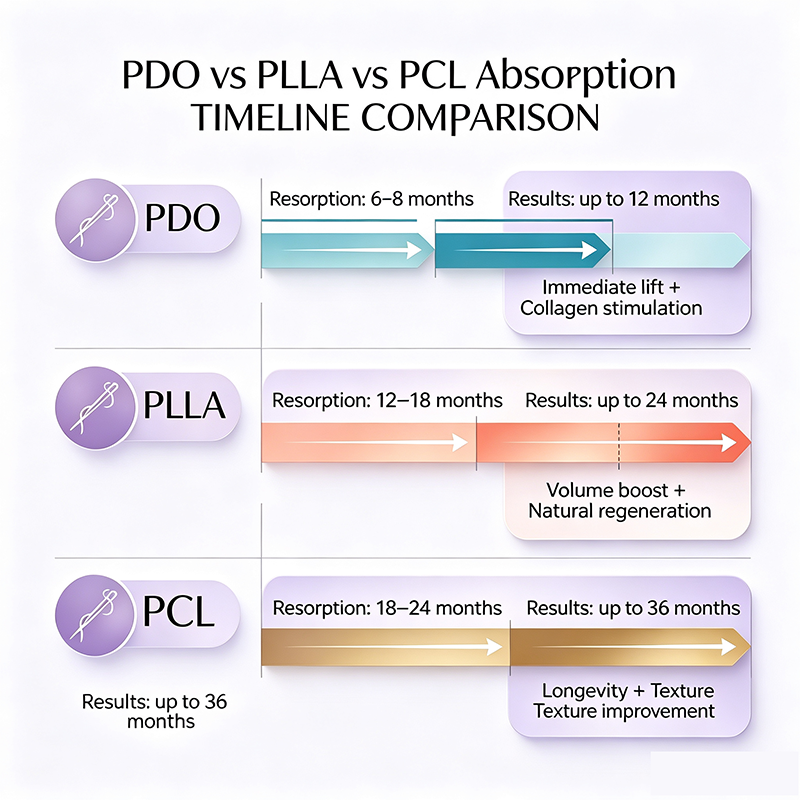
- PLLA (poly-L-lactic acid): absorbs in 2 years or more; stronger, longer collagen stimulation; results up to 18–24 months. A premium, long-term material.
- PCL (polycaprolactone): absorbs in more than 2 years; sustained bio-stimulation; results 12–18 months. A mid-range structural option.
- PDO: absorbs in 3-6 months; moderate collagen stimulation; results 6–9 months. The entry-level, most widely used material.
From a chemistry standpoint, the key difference is degradation rate — PDO's faster absorption makes it ideal for first-time clients and high-turnover protocols, while PLLA/PCL suit clients who want longer-lasting outcomes. The clinical comparison is detailed in PDO vs PLLA vs PCL, and all three materials are available in our thread materials collection. For the complete PDO line in one place — mono, screw, multi, cog, and cone cog — browse the PDO thread collection.
Why "PDO" Matters for Quality Verification
Not all "PDO threads" are equal. The label only describes the polymer; quality is decided by manufacturing:
- Material certification — USP Class VI or equivalent biocompatibility documentation.
- Sterilization validation — EO process with per-batch biological indicators.
- Traceability — lot numbers linking every box to production and QC records.
This guide is educational and not medical advice.
Frequently Asked Questions
What does PDO stand for in threading?
Polydioxanone — a biocompatible, absorbable synthetic polymer used in medical sutures since the 1980s.
Is polydioxanone safe for the body?
Yes — PDO is USP Class VI biocompatible and degrades into water-soluble byproducts cleared naturally by the body, with 40+ years of surgical use.
How long does polydioxanone take to dissolve?
PDO is fully absorbed in 3-6 months; the collagen it stimulates persists longer, which is why results outlast the material.
Is PDO the same as PLLA or PCL?
No — all three are absorbable polymers, but they differ in degradation time and collagen effect. PDO absorbs fastest (3-6 months); PLLA and PCL last 12-18 months.
Educational content only — not medical advice. Results vary by individual. © 2026 Auro Technology Limited.