
Polydioxanone (PDO) Threads Explained
Polydioxanone (PDO) threads are absorbable, medical-grade sutures engineered for aesthetic lifting and collagen stimulation. Unlike marketing descriptions, this guide explains the material itself: how polydioxanone behaves in the body, its strength and absorption kinetics, the clinical evidence behind it, and why material quality determines outcomes.
For the basics, see What Are PDO Threads?; for the meaning and chemistry of the acronym, What Does PDO Mean?; for the procedure these threads power, What Is a PDO Thread Lift?; and for the complete topic, our PDO Threads: The Complete Guide.
On this page:
- What is polydioxanone?
- How PDO threads interact with the body
- Strength and absorption kinetics
- What the clinical evidence shows
- Polydioxanone vs. other suture materials
- Why material quality matters
- Frequently asked questions
What Is Polydioxanone?
Polydioxanone is a synthetic, crystalline polyester introduced in 1981 as an absorbable suture for cardiovascular and general surgery. Its defining trait is controlled hydrolytic degradation: the polymer breaks down into water-soluble byproducts that the body clears naturally, leaving no permanent material. In aesthetics, polydioxanone is drawn into monofilament threads of 26G–30G for collagen stimulation and lifting.
Three engineering properties make it clinically valuable:
- Tensile strength — strong enough to support tissue during the early healing window.
- Elastic memory — controlled flexibility that reduces tissue drag during insertion.
- Predictable absorption — fully absorbed in 4–6 months, with results outlasting the material.
How PDO Threads Interact with the Body
When a PDO thread is placed under the skin, the body responds in two phases:
- Immediate mechanical phase — the thread physically supports and repositions tissue.
- Biological phase — the thread triggers a mild foreign-body response that recruits fibroblasts, the cells that deposit collagen I and III around the thread channel. Collagen remodeling peaks at 3–6 months, which is why results improve progressively after placement.
This dual mechanism is the entire basis of PDO thread lifting — a structural lift today, a collagen boost that builds for months.
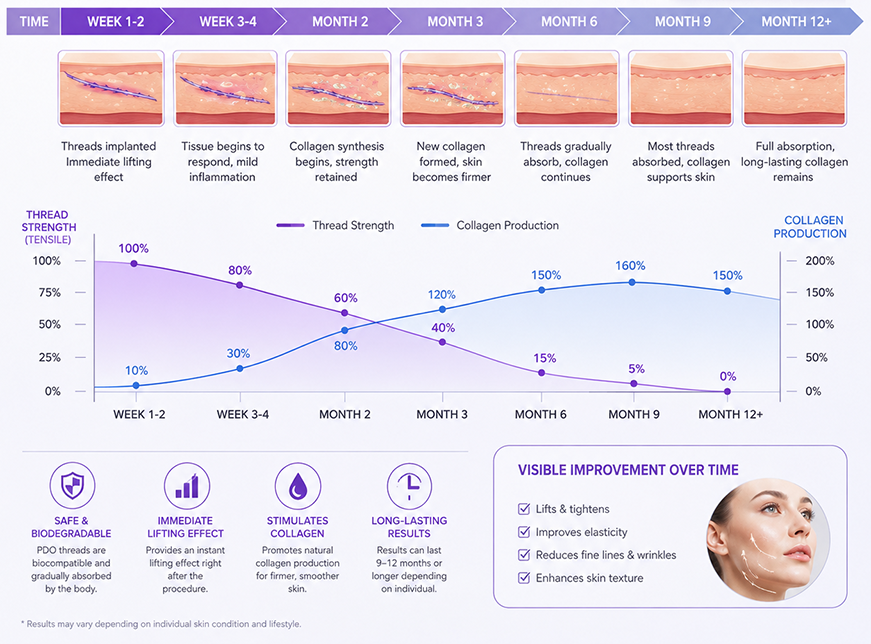
Strength and Absorption Kinetics
Understanding the timeline helps set realistic expectations:
- Weeks 0–3: PDO retains roughly 50% of its tensile strength — the period of active mechanical lift.
- Months 1–2: strength declines as hydrolysis proceeds; the collagen scaffold begins to take over.
- Months 4–6: threads are fully absorbed; results are sustained by newly formed collagen.
- Months 6–9+: collagen remodels and gradually fades; maintenance treatments extend results.
The practical consequence: a thread lift is a collagen investment, not a permanent implant — which is exactly why the material suits patients who want natural, non-permanent rejuvenation.
What the Clinical Evidence Shows
- Collagen induction: studies report increased collagen I/III deposition around PDO thread channels, peaking 3–6 months after placement.
- Safety profile: polydioxanone has 40+ years of surgical use; aesthetic complications are predominantly mild and technique-related.
- Material standard: USP Class VI biocompatibility — the same implant-grade benchmark used for cardiac sutures.
In aesthetics — a YMYL category — this evidence base is what separates manufacturer-grade content from marketing claims.
Polydioxanone vs. Other Suture Materials
PDO is one of three absorbable polymers used in threads:
- PDO (polydioxanone): absorbs in 3-6 months; results 6–9 months; the entry-level, most widely used material.
- PLLA (poly-L-lactic acid): absorbs in 2 years or more; results up to 18–24 months; premium long-term option.
- PCL (polycaprolactone): absorbs in more than 2 years; results 12–18 months; structural mid-range option.
The clinical comparison is detailed in PDO vs PLLA vs PCL.
Why Material Quality Matters
The label "PDO" only describes the polymer — quality is decided by manufacturing: USP Class VI material certification, EO sterilization with per-batch validation, and lot-level traceability. Our PDO surgical suture collection documents these standards, and our manufacturing standards guide walks through every quality checkpoint.
For clinics building a protocol, the full PDO thread collection covers mono, screw, multi, cog, and cone cog in one place.
This guide is educational and not medical advice.
Frequently Asked Questions
How long does polydioxanone take to dissolve?
PDO is fully absorbed in 3-6 months through hydrolytic degradation; the collagen it stimulates persists longer, which is why results outlast the material.
Is polydioxanone the same as PLLA or PCL?
No — all three are absorbable polymers but differ in degradation time and collagen effect. PDO absorbs fastest (3-6 months); PLLA and PCL last 12-18 months.
How strong are PDO threads?
PDO retains roughly 50% of tensile strength at 3 weeks — strong enough to support tissue during the early healing window before collagen takes over.
Where can I buy medical-grade PDO threads?
AuroThread supplies the full PDO range with USP Class VI certification, EO sterilization, and lot traceability — browse the collection or contact our wholesale team.
Educational content only — not medical advice. Results vary by individual. © 2026 Auro Technology Limited.
Related Products

PDO Mono Thread 26G — skin tightening & fine lines
View Product
Tornado Screw Thread — nose, lips & folds
View Product