
PCL Thread Lift: The Ultimate Long-Lasting Collagen Booster

Polycaprolactone (PCL) thread lifts have emerged as the gold standard for patients seeking long-lasting, minimally invasive facial rejuvenation. Unlike traditional PDO threads that dissolve within 3-6 months, PCL threads offer sustained lifting and collagen stimulation for up to 2-3 years. According to a groundbreaking 2025 animal study published in the Iranian Journal of Basic Medical Sciences, PCL threads demonstrated superior collagen density enhancement compared to PDO and PLLA threads in UVB-exposed aging rat models. The study found that PCL threads significantly increased dermal collagen density and COL3A1 gene expression while decreasing the COL1/COL3 ratio toward a more youthful profile .
A nationwide cross-sectional analysis of 106,639 thread-lift cases across 105 clinics in Japan revealed important clinical trends. The study, published in Aesthetic Plastic Surgery (2026), found that PDO was used in 57.2% of cases, predominantly in younger patients (20s-30s), whereas PCL was more common in older patients. Interestingly, the mean thread count was significantly higher in the PDO group than in the PCL group (10.52 vs. 6.57, p < 0.001), suggesting that PCL threads provide more lifting power per thread . For practitioners seeking premium PCL threads, Aurothread's PCL thread collection offers a comprehensive range including cog, screw, and mono threads designed for various clinical applications.
PCL vs PDO: The Science Behind the Longevity
The primary difference between PCL and PDO threads lies in their molecular structure and degradation rates. PDO (Polydioxanone) is a synthetic absorbable polymer that has been used in medical sutures for decades. According to the Aesthetics comparison, PDO threads typically dissolve within 3-6 months, with collagen stimulation effects lasting up to 12-18 months. While they provide immediate mechanical lifting through barbed or cogged designs, their shorter lifespan means results diminish faster, especially in areas with significant movement like the jawline or cheeks .
PCL (Polycaprolactone) is a longer-lasting biocompatible material that degrades slowly over 18-24 months. The 2025 animal study comparing PDO, PLLA, and PCL threads in UVB-exposed aging rats provided compelling evidence for PCL's superiority. Researchers found that PCL threads significantly increased dermal collagen density compared to both PDO and PLLA groups, with the PCL group achieving the highest collagen density among all treatment groups. Additionally, PCL threads demonstrated the lowest COL1/COL3 ratio, indicating a reversal toward a more youthful collagen composition .
The study also examined COL3A1 gene expression, which is crucial for type III collagen production. Type III collagen is essential for skin elasticity and is the first collagen produced during wound healing. The PCL thread group displayed the highest relative COL3A1 expression among all thread implantation groups, significantly higher than the young negative control group. This suggests that PCL threads not only stimulate more collagen production but also promote a more beneficial collagen type ratio for skin health .
Clinical Evidence: What the Data Shows
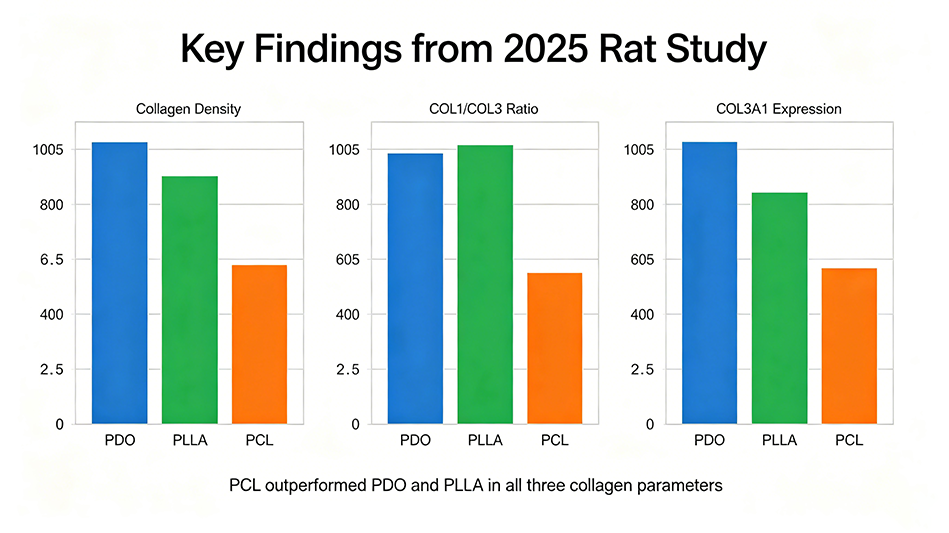
The 2025 study published in the Iranian Journal of Basic Medical Sciences represents one of the most comprehensive comparative analyses of thread materials to date. Researchers divided 30 female Wistar rats into six groups: young negative control (YNC), old negative control (ONC), old positive control exposed to UVB (OPC), and three thread implantation groups (PDO, PLLA, and PCL) exposed to UVB. The rats were exposed to 840 mJ/m² UVB for 4 weeks to simulate photoaging, followed by thread implantation .
The results were striking. In the OPC group, collagen density decreased significantly due to UVB-induced collagen fragmentation and reduced production. However, all thread implantation groups showed significant increases in collagen density compared to the photoaged group. Specifically, the PCL thread group exhibited significantly higher collagen density than the other thread implantation groups and even the young negative control group .
The COL1/COL3 ratio analysis provided additional insights. Aging and UVB exposure increase this ratio because type III collagen is more susceptible to damage than type I collagen. The PCL group demonstrated the lowest COL1/COL3 ratio among all thread groups, indicating the most effective reversal of age-related collagen changes. This is clinically significant because a lower COL1/COL3 ratio is associated with more elastic, youthful skin .
Mechanical Properties: Why PCL Provides Stronger Lifting
Beyond collagen stimulation, PCL threads offer superior mechanical properties for immediate lifting. A 2025 biomechanical study published in the Proceedings of the Institution of Mechanical Engineers evaluated the degradation and mechanical properties of PCL cog threads under simulated physiological conditions. The study found that PCL threads retained sufficient mechanical integrity to endure 100 loading cycles after 180 days of degradation, demonstrating their durability under repetitive stress .
The tensile strength tests showed a reduction in maximum load-bearing capacity of only 13-19% over 180 days, confirming that PCL threads maintain their lifting capability significantly longer than PDO threads. This mechanical durability is particularly important for areas requiring sustained support, such as the jawline, cheeks, and brow. The study concluded that biodegradable PCL cog threads are promising materials for long-term tissue reinforcement .
According to the Diaminy Medical Aesthetics analysis, PCL threads also offer greater flexibility and elasticity than PDO threads, resulting in less pain and discomfort during the procedure. The slow degradation of PCL releases lactic acid as a byproduct, which activates fibroblasts over a longer period, making results more gradual but longer-lasting. Patients often see initial improvements within 4-6 weeks, with full effects appearing after 3-6 months and benefits persisting for up to 2 years .
Clinical Applications and Patient Selection
The choice between PCL and PDO threads should be guided by patient goals, anatomy, and treatment timeline. According to the Japanese nationwide study, PDO threads are predominantly used in younger patients (20s-30s) who may be seeking subtle, shorter-term enhancement or are new to thread lifting. PCL threads are more common in older patients who require more significant lifting and longer-lasting results .
PCL threads are particularly suited for areas requiring stronger support and sustained collagen stimulation, such as:
-
Jawline contouring: PCL cog threads provide structural support and definition
-
Midface lifting: Cheek and malar area elevation
-
Brow lifting: Temporal and lateral brow suspension
-
Neck rejuvenation: Cervical and submental area tightening
PDO threads remain an excellent choice for:
-
Fine lines and delicate areas: Perioral, periorbital region
-
Combination treatments: Supplementary lifting alongside fillers or biostimulators
-
Patients new to thread lifts: Lower cost and faster recovery
The Diaminy Medical Aesthetics guide notes that PCL treatments are generally 20-30% more expensive than PDO treatments due to the advanced material and longer-lasting results. However, the extended durability means fewer touch-ups over time, making PCL potentially more cost-effective in the long run .
Conclusion: Choosing the Right Thread for Your Practice
PCL thread lifts represent a significant advancement in minimally invasive facial rejuvenation. The evidence from animal studies, biomechanical testing, and nationwide clinical data supports PCL as the superior choice for patients seeking long-lasting lifting and collagen stimulation. The 2025 rat study demonstrated that PCL threads outperformed both PDO and PLLA in enhancing dermal collagen density, reducing the COL1/COL3 ratio toward youthful levels, and increasing COL3A1 gene expression .
The nationwide Japanese study of 106,639 cases confirmed that material selection is increasingly individualized and strategy-driven. PCL threads are preferred for older patients requiring more significant correction, while PDO threads remain popular for younger patients seeking shorter-term enhancement . For practitioners building their thread lifting practice, offering both PDO and PCL options allows for customized treatment plans based on patient age, skin laxity, and aesthetic goals.
For high-quality PCL threads with documented manufacturing standards and CE certification, Aurothread's PCL thread collection offers a comprehensive range including cog, screw, mono, and mesh threads designed for various clinical applications. Combined with complementary products such as blunt cannulas for safe insertion and PLLA fillers for volume restoration, practitioners can develop comprehensive rejuvenation protocols. As with any medical procedure, proper patient selection, realistic expectations, and technique excellence are essential for optimal outcomes.