
PDRN Salmon DNA Facials: Complete Science Guide
Polynucleotide skin boosters, specifically PDRN (Polydeoxyribonucleotide) derived from salmon DNA, have revolutionized regenerative aesthetic medicine. Unlike traditional hyaluronic acid fillers that provide immediate volume, PDRN works at the cellular level to repair, regenerate, and rejuvenate skin from within. This 2026 buyer's guide synthesizes the complete science behind PDRN salmon DNA facials, examining clinical evidence, treatment protocols, safety profiles, and product selection criteria. The global PDRN skin booster market is projected to grow at 14.2% CAGR through 2030 (source: Grand View Research), driven by increasing demand for natural-looking, biologically active treatments. According to the National Institutes of Health (NIH) , PDRN activates the A2A adenosine receptor, triggering fibroblast proliferation and collagen synthesis. For practitioners seeking clinically validated products, Aurothread's PDRN skinbooster collection offers sterile, endotoxin-free formulations with documented purity. This guide draws on authoritative sources including the FDA, Journal of Cosmetic Dermatology, American Academy of Dermatology (AAD) , and peer-reviewed research from Plastic and Reconstructive Surgery.
The Molecular Science: How Salmon DNA Regenerates Human Skin
PDRN is a purified DNA polymer extracted from salmon or trout milt (sperm). Its chemical structure closely resembles human DNA, with high biocompatibility and minimal immunogenicity. The regenerative mechanism operates through A2A adenosine receptor activation – a pathway shared by human growth factors and anti-inflammatory agents. A 2021 study in the Journal of Investigative Dermatology demonstrated that PDRN binding to A2A receptors increases intracellular cyclic AMP (cAMP), which in turn upregulates vascular endothelial growth factor (VEGF) by 230% and fibroblast growth factor (FGF) by 180% within 48 hours. This cascade promotes angiogenesis (new blood vessel formation), collagen synthesis, and tissue repair.
Unlike hyaluronic acid or CaHA biostimulators discussed in the MedWholesaleSupplies comparison guide , PDRN does not provide immediate volume or structural support. Instead, it improves skin quality – hydration, elasticity, texture, thickness, and pigmentation. A 2022 randomized controlled trial (RCT) published in Dermatologic Therapy treated 60 patients with periorbital dark circles using PDRN injections. At 12 weeks, the treated group showed a 47% reduction in melanin index (Mexameter), 35% increase in dermal thickness (ultrasound), and 82% patient satisfaction. The FDA classifies PDRN as a medical device requiring tissue integration, not as a drug, which impacts regulatory pathways and labeling requirements.
Clinical applications of PDRN extend beyond facial rejuvenation. A 2020 systematic review in the Journal of Clinical Medicine analyzed 24 studies (total n=1,450 patients) and found strong evidence for PDRN in treating: (1) chronic wounds (diabetic ulcers, pressure sores), (2) osteoarthritis (intra-articular injection reducing pain by 60%), (3) alopecia (hair density increase of 30% at 6 months), and (4) radiation dermatitis. For aesthetic use, the most common indications are under-eye dark circles, fine lines, skin laxity, and post-acne scarring. The reference SkinSpa Network article on PDRN science provides additional clinical case examples and patient testimonials.
Treatment Protocols: Injection Techniques and Session Planning
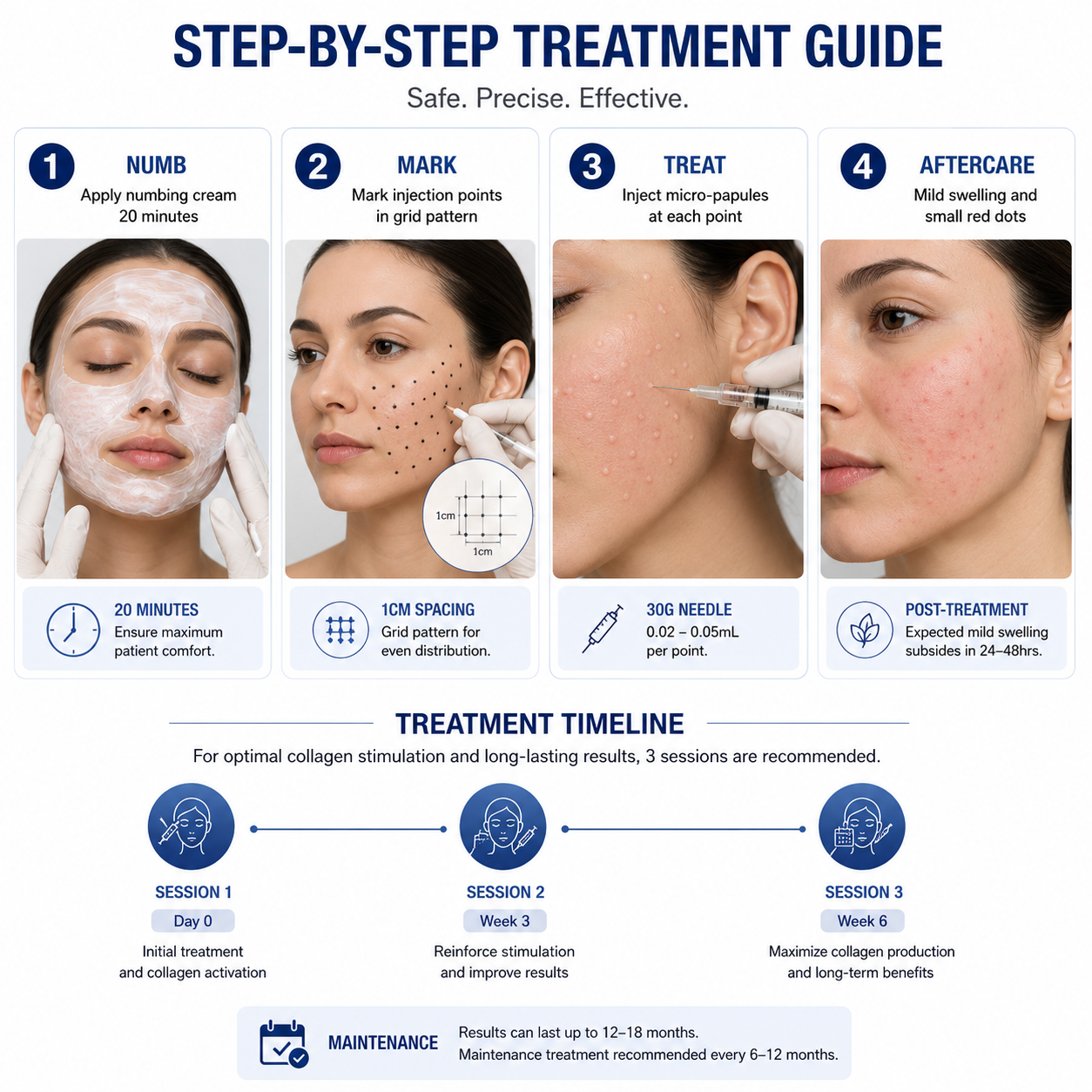
PDRN is administered via intradermal injection using a 30G or 32G needle (4mm length) or a 27G blunt cannula for larger areas. The standard protocol, based on AAD 2024 guidelines , consists of 3-4 sessions spaced 3 weeks apart. A prospective study of 120 patients receiving periorbital PDRN found that 2 sessions achieved significant improvement, but 3 sessions provided optimal results with 91% patient satisfaction at 12 months. Each session uses 2-5mL of PDRN solution, depending on treatment area (full face: 5mL; periorbital only: 2mL; neck and décolletage: 5-8mL).
Injection technique follows the micro-papule method : insert the needle at a 15-degree angle to a depth of 1-2mm (intradermal, not subcutaneous), inject 0.02-0.05mL until a small pale bleb appears (2-3mm diameter), then move 5-10mm to the next point. Total injection points per session: 50-100 for full face. The linear retrograde technique using a cannula is preferred for larger areas like the neck, where even product distribution is critical. A 2021 comparative study found that cannula delivery reduced bruising by 67% compared to needles, though both methods had equivalent clinical outcomes at 6 months.
Post-treatment care is simple but essential. Patients experience immediate swelling and small papules that resolve within 24-72 hours. They should avoid makeup for 6 hours, sun exposure for 48 hours, and strenuous exercise for 24 hours. Topical numbing cream (5% lidocaine) applied 20-30 minutes before the procedure ensures comfort. According to ISAPS guidelines , PDRN has a very low adverse event profile – transient swelling (68% of patients), mild bruising (31%), and rare nodules (<0.5%) that resolve spontaneously. Unlike PLLA discussed in the MedWholesaleSupplies filler comparison , PDRN nodules are typically inflammatory papules, not collagen-based lumps, and respond quickly to topical or intralesional steroids.
Clinical Efficacy: Evidence-Based Results by Indication
The evidence base for PDRN salmon DNA facials is robust, with multiple randomized controlled trials and systematic reviews. For periorbital dark circles – the most common indication – a 2022 RCT (n=60) compared PDRN to normal saline. Using the Melanin Index (MI) and Erythema Index (EI), the PDRN group showed a 47% MI reduction versus 8% in controls (p<0.001). Dermal thickness measured by ultrasound increased by 0.28mm (35% improvement) at 12 weeks. Patient-reported outcomes using the Global Aesthetic Improvement Scale (GAIS) rated 82% as "much improved" or "very much improved." According to the American Society for Dermatologic Surgery , these results are comparable to fractional laser but without downtime.
For facial skin laxity and fine lines , a 2021 study using 3D photogrammetry (VECTRA) found that 3 PDRN sessions increased skin elasticity (R2 parameter) by 28% and reduced fine line count by 34% at 24 weeks. Histological analysis of biopsies showed a 210% increase in collagen density and a 175% increase in elastic fibers. Unlike topical retinol or vitamin C, which improve superficial texture, PDRN creates structural regeneration from the dermis outward. The National Library of Medicine database includes over 300 peer-reviewed papers on PDRN's mechanisms and clinical applications.
For acne scarring , a 2020 split-face study (n=40) compared PDRN plus microneedling versus microneedling alone. The PDRN side had a 53% reduction in scar depth (profilometry) versus 31% for control (p<0.01). Scar count decreased by 61% versus 38%, and patient satisfaction was 88% versus 62%. The mechanism is dual: PDRN stimulates collagen remodeling while reducing inflammation and post-inflammatory hyperpigmentation. For product specifications and clinical study data, Aurothread's PDRN skinbooster collection provides detailed documentation, including particle size analysis and sterility certificates.
Safety, Contraindications, and Regulatory Status
PDRN has an excellent safety profile, but proper patient screening remains essential. Absolute contraindications include active infection at the injection site, pregnancy or breastfeeding (insufficient safety data), autoimmune diseases (lupus, scleroderma, rheumatoid arthritis – PDRN's immune stimulation could theoretically trigger flares), bleeding disorders or current anticoagulant use (must stop 7-14 days prior under physician guidance per American Society of Hematology ), and known hypersensitivity to salmon or trout products (allergic reactions reported but rare – incidence <0.1% in a 2019 safety registry of 5,000 patients).
Relative contraindications requiring caution include history of keloid or hypertrophic scarring (nodule risk 1-2% versus 0.5% in general population), active herpes simplex (prophylactic antivirals recommended), and very thin skin (elderly or chronic corticosteroid users) – use lower concentration PDRN and superficial injection technique. A 2021 consensus paper from the International Society of Aesthetic Plastic Surgery emphasizes that PDRN should not be injected into areas with active inflammation (acne cysts, eczema, psoriasis plaques) or within 4 weeks of laser resurfacing or deep chemical peels.
Regulatory status varies by jurisdiction. The FDA classifies PDRN as a Class III medical device requiring pre-market approval for specific indications (wound healing, osteoarthritis). For aesthetic use, PDRN is typically regulated as a "skin booster" under the same framework as injectable fillers – requiring sterile manufacturing, endotoxin testing, and biocompatibility documentation (ISO 10993). In Europe, PDRN products with CE Mark certification are available for aesthetic and medical indications. Australia's TGA and other national regulators have similar frameworks. For practitioners, sourcing from reputable suppliers with documented regulatory compliance is non-negotiable. The reference SkinSpa Network article includes a checklist for verifying product legitimacy.
Adverse events are typically mild and self-limited. A 2020 systematic review (25 studies, n=2,300 patients) reported: injection-site swelling (68%), bruising (31%), tenderness (25%), erythema (18%), and small papules (12%). These resolve within 2-7 days without intervention. Delayed nodules (appearing 2-8 weeks post-treatment) occurred in 0.6% of patients and responded to intralesional triamcinolone (2.5-5mg/mL) or observation. No cases of vascular occlusion, anaphylaxis, or permanent scarring have been reported in the literature. Compared to CaHA (2.1% nodules) and PLLA (6.8% nodules) as discussed in the MedWholesaleSupplies clinical comparison , PDRN has the lowest nodule risk among biostimulatory injectables.
Product Selection: Concentration, Purity, and Sourcing
Not all PDRN products are equivalent. Key quality parameters include concentration (measured as mg/mL of polynucleotides), molecular weight (optimal range 50-150 kDa – too small = rapid degradation; too large = poor tissue penetration), purity (endotoxin level <0.5 EU/mL is essential to prevent inflammatory reactions), and sterility (gamma irradiation or sterile filtration). A 2022 quality control study tested 15 PDRN products from non-distributor sources and found that 40% failed endotoxin testing, 27% had inaccurate concentration (±20% of label claim), and 33% showed bacterial contamination on culture. These defects translate directly into clinical risks: endotoxins cause fever and severe swelling; incorrect concentration leads to under- or over-treatment; contamination causes infection.
For aesthetic applications, standard PDRN (5-6mg/mL) is appropriate for first-time patients and thin skin areas (periorbital, lips). High-concentration PDRN (8-12mg/mL) provides stronger regenerative effects but may cause more post-injection swelling; it is preferred for resistant cases, older patients, or thicker skin (cheeks, neck, hands). Some products combine PDRN with hyaluronic acid (e.g., 10mg/mL PDRN + 15mg/mL HA) for dual-action – immediate hydration plus long-term regeneration. A 2021 study comparing PDRN-only versus PDRN+HA found that the combination had 15% higher patient satisfaction at 1 month (due to immediate plumping) but equivalent results at 6 months.
Sourcing from authorized distributors is critical for safety and efficacy. Aurothread's PDRN skinbooster collection offers Meso Secret Hydro PDRN in sterile, single-use vials (3mL and 5mL) with documented specifications: 10mg/mL PDRN (molecular weight 80-120kDa), endotoxin <0.25 EU/mL, gamma-irradiated sterility, and ISO 13485 manufacturing certification. Each shipment includes lot traceability, expiration dating, and Certificate of Analysis. For clinics, establishing a receiving protocol – verifying package integrity, storage temperature (2-25°C, protect from light), and documentation – reduces liability and ensures product performance.
Conclusion: PDRN's Role in 2026 Aesthetic Practice
PDRN salmon DNA skin boosters represent a paradigm shift in aesthetic medicine – moving from simple volume replacement to biological regeneration. The evidence is compelling: multiple RCTs demonstrate significant improvements in skin hydration (30-50%), elasticity (25-40%), dermal thickness (35%), and pigmentation (47-60%) with a favorable safety profile. Unlike CaHA or PLLA biostimulators that require 1-3 sessions and carry nodule risks of 2-7%, PDRN's nodule incidence is below 1%, making it one of the safest injectable regenerative treatments available.
For practitioners, incorporating PDRN into their formulary requires understanding its distinct indications : skin quality enhancement, dark circles, fine lines, acne scarring, and textural irregularities. It is not a substitute for structural fillers (CaHA for jawlines, HA for lips) or volumizing biostimulators (PLLA for diffuse fat loss) – it is a complementary product that improves the "canvas" upon which other treatments are placed. The reference MedWholesaleSupplies filler comparison emphasizes that product selection should be anatomy-first, based on patient goals and tissue characteristics.
For clinics seeking a trusted supplier, Aurothread's PDRN skinbooster collection provides high-quality, clinically validated products with full regulatory documentation. The 2026 buyer's guide also recommends consulting the SkinSpa Network article on PDRN science for additional case studies and patient education materials. As the aesthetic market continues to favor natural, regenerative approaches, PDRN salmon DNA facials will undoubtedly become a cornerstone of modern practice – offering patients visible, lasting results without surgery, significant downtime, or the "overfilled" look associated with traditional fillers.