
PDO vs PLLA vs PCL Thread Lifts — Which Lifting Thread Actually Fits Your Patient
1. What Are PDO, PLLA, and PCL Threads?
Absorbable lifting threads are FDA- and CE-cleared medical devices used in non-surgical facial rejuvenation. They are inserted under the skin via a fine cannula or needle to deliver two distinct clinical effects:
1. Immediate mechanical lift — barbs or cogs along the thread physically reposition sagging tissue.
2. Long-term biological remodeling — the polymer triggers neocollagenesis (new collagen formation), improving skin density and elasticity over 3–6 months.
The three dominant polymer families on the market are:
· PDO (Polydioxanone) — the original and most widely used thread polymer, in clinical use since the 1980s.
· PLLA (Poly-L-Lactic Acid) — same biostimulator family as Sculptra and Angelfill fillers.
· PCL (Polycaprolactone) — the newest generation, with the longest in-vivo lifespan and strongest collagen response.
How All Three Polymers Work in the Skin
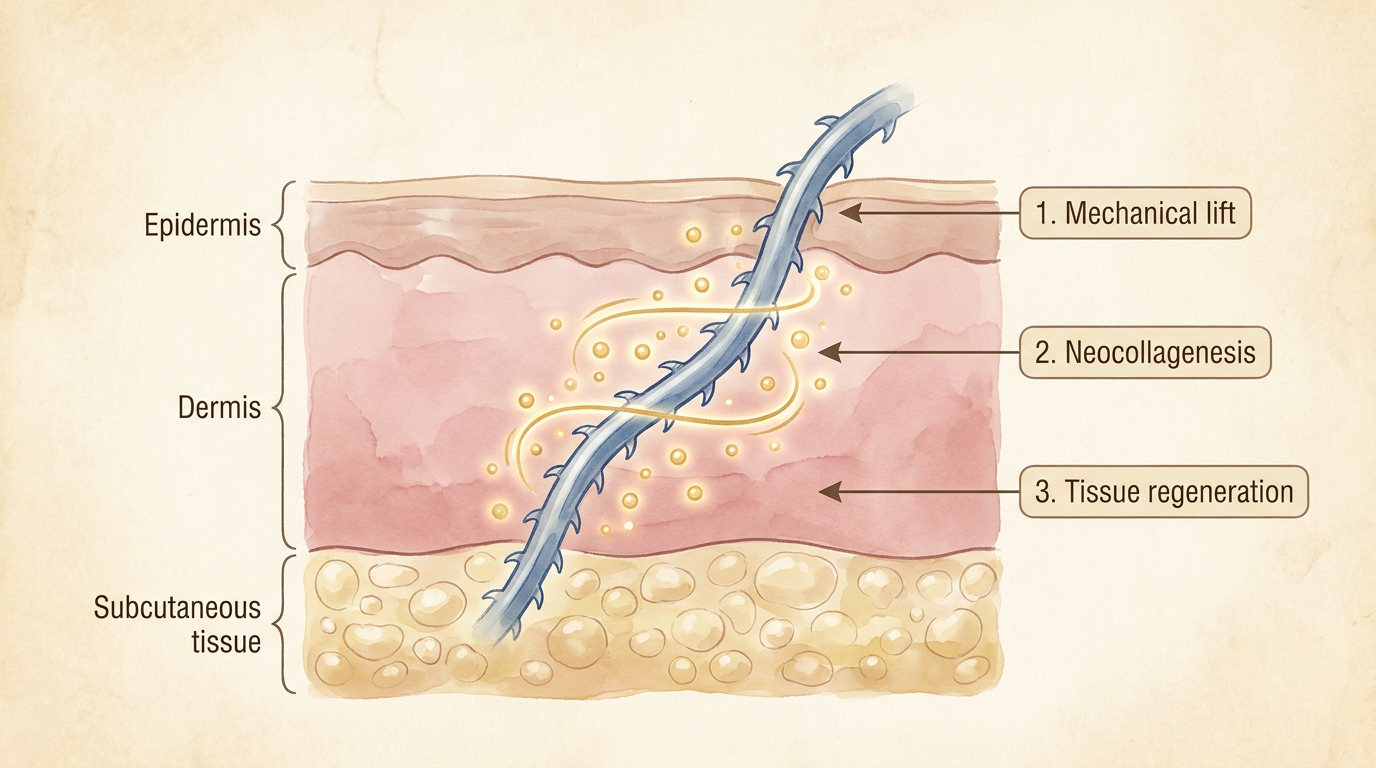
· Phase 1 (Day 0 – Week 2): Mechanical lift and inflammatory response.
· Phase 2 (Week 2 – Month 6): Fibroblast activation, neocollagenesis, and tissue remodeling.
· Phase 3 (Month 6 onward): Polymer hydrolysis; collagen scaffold sustains the lift.
The difference between PDO, PLLA, and PCL lies in how long Phase 2 lasts and how strong the collagen response is.
2. PDO Threads — Features, Benefits & Best Use Cases
Material Profile
· Polymer: Polydioxanone (PDO)
· In-vivo lifespan: 6–8 months
· Collagen stimulation: Mild to moderate
· Clinical history: Used in absorbable surgical sutures since the 1980s; thread-lift application since approximately 2004
PDO Thread Types
· Mono PDO: Smooth, single-filament threads for skin tightening and texture improvement
· Screw / Tornado PDO: Twisted filaments for mild volumizing
· Cog PDO: Barbed threads for mechanical lifting
Benefits for Clinics
· Lowest unit cost — most accessible price point for entry-level patients
· Largest body of clinical evidence and longest safety record
· Suitable for first-time thread patients who want to "try" the procedure
· Ideal for short-term refresh treatments before weddings, events, or photo shoots
Best Use Cases
· Patients aged 30–45 with mild laxity
· Skin quality and texture improvement (mono PDO)
· Eyebrow lift and small-zone treatments
· Combination protocols where PDO supports a primary PCL lift
3. PLLA Threads — Features, Benefits & Best Use Cases
Material Profile
· Polymer: Poly-L-Lactic Acid (PLLA)
· In-vivo lifespan: 12–24 months
· Collagen stimulation: Moderate to strong
· Related products: Same polymer family as Sculptra and Angelfill biostimulator fillers
Benefits for Clinics
· Stronger and longer-lasting collagen response than PDO
· Ideal for patients who prefer gradual, natural-looking improvement
· Excellent for neck, décolletage, and thin-skinned zones
· Pairs naturally with PLLA biostimulator filler protocols
Best Use Cases
· Patients aged 38–50 with mild to moderate laxity
· Clients seeking long-term tissue quality improvement over dramatic lift
· Neck and décolletage rejuvenation
· Hybrid protocols combining PLLA threads + PLLA biostimulator filler
4. PCL Threads — Features, Benefits & Best Use Cases
Material Profile
· Polymer: Polycaprolactone (PCL)
· In-vivo lifespan: 18–36 months
· Collagen stimulation: Strong and sustained
· Tensile strength: Highest among the three polymers; superior anchoring capacity
Comprehensive PCL Thread Range (Aurothread Catalogue)
· Mono PCL: Skin tightening and fine-line improvement
· Screw / Tornado PCL: Volumizing and contouring
· Cog PCL 3D / 4D / 6D: Primary mechanical lifting at varying cog densities
· Molding Cog PCL: Heavy-tissue applications (jawline, jowls)
· Mesh PCL: Broad-zone lifting and structural support
· Multi-thread bundles: Time-efficient large-area treatment
· 30G Eye Threads: Periorbital and crow's-feet treatment
· 19G L-Shape Nose Threads: Non-surgical rhinoplasty
Benefits for Clinics
· Longest result duration on the market — up to 3 years per session
· Strongest collagen-stimulation response of any absorbable polymer
· Highest per-session revenue and lowest patient churn
· Best per-month-of-result value despite higher unit cost
· Comprehensive range allows entire treatment plan from a single polymer family
Best Use Cases
· Patients aged 45–65 with moderate to significant laxity
· Premium and signature lifting protocols
· Jawline, jowl, and midface repositioning
· Non-surgical rhinoplasty (PCL nose threads)
· Patients who want maximum return on a single treatment investment
5. PDO vs PLLA vs PCL: Full Comparison Table
|
Parameter |
PDO |
PLLA |
PCL |
|
Full polymer name |
Polydioxanone |
Poly-L-Lactic Acid |
Polycaprolactone |
|
In-vivo duration |
6–8 months |
12–24 months |
18–36 months |
|
Collagen stimulation |
Mild to moderate |
Moderate to strong |
Strong and sustained |
|
Tensile strength |
Moderate |
Moderate |
Highest |
|
Immediate lift effect |
Strong (with cogs) |
Moderate |
Strong and durable |
|
Long-term lift retention |
3–6 months |
9–15 months |
15–24 months |
|
Maintenance interval |
Every 6–9 months |
Every 12–18 months |
Every 18–30 months |
|
Ideal patient age range |
30–45 |
38–50 |
45–65 |
|
Indication intensity |
Mild laxity |
Mild to moderate |
Moderate to significant |
|
Unit cost |
$ |
$$ |
$$$ |
|
Cost per month of result |
Highest |
Moderate |
Lowest (best value) |
|
Patient satisfaction (12-month) |
65–75% |
78–85% |
88–94% |
|
Recommended clinic positioning |
Entry-level / refresh |
Mid-range / wellness |
Premium / signature |
6. Treatment Zones: Which Thread for Which Area
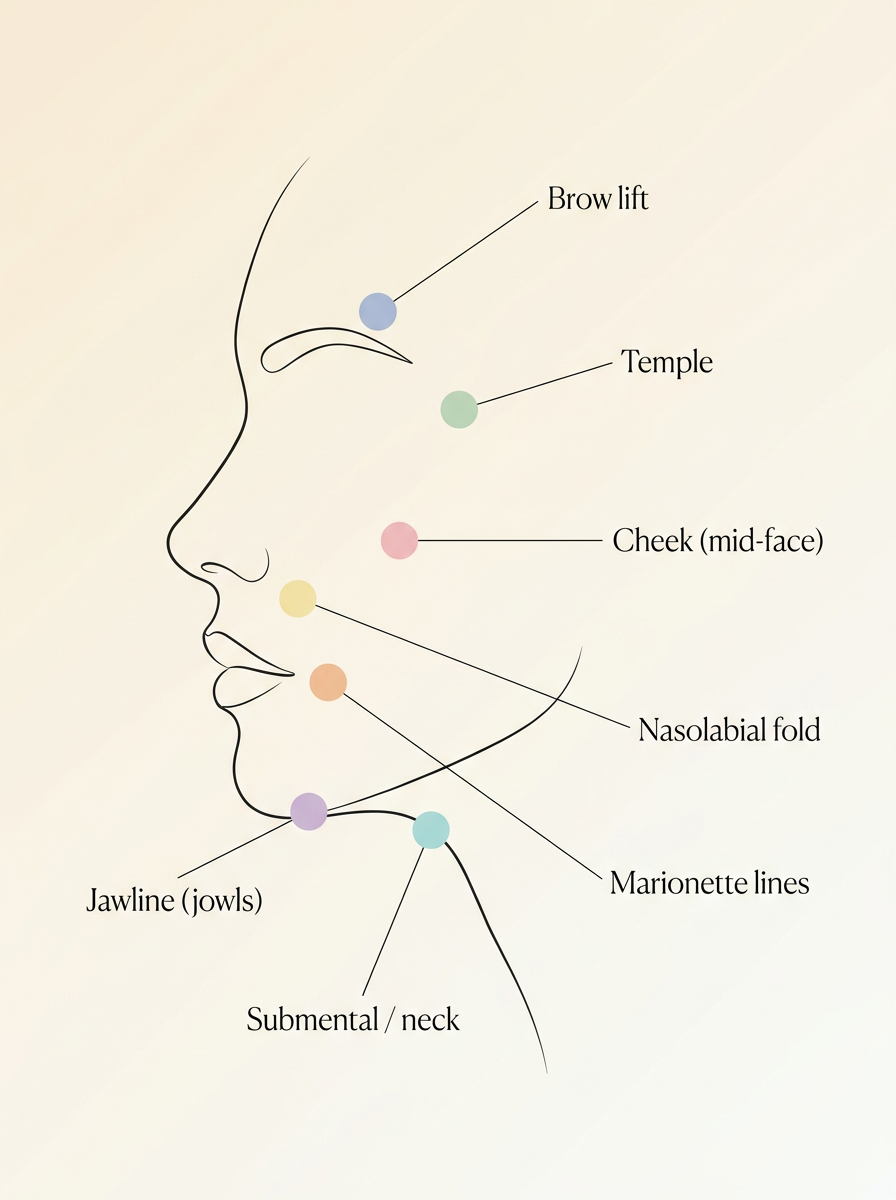
Brow and Temple
Recommended: PDO Cog (short) or PCL Cog 3D. Mono threads as supporting layer. Avoid heavy-density cogs in this zone.
Mid-cheek and Zygomatic Area
Recommended: PCL Cog 3D / 4D / 6D depending on tissue weight. Anchor at temporal fascia. This is the signature zone where PCL clearly outperforms alternatives.
Nasolabial Fold and Marionette Lines
Recommended: PCL Cog 4D combined with mid-face vector lifting. Address from above rather than chasing the line directly.
Jawline and Jowls
Recommended: PCL Molding Cog or Cog 6D. 2–4 threads per side based on jowl volume. PDO underperforms in heavier tissue.
Neck and Submental Area
Recommended: PLLA mono threads or PCL mono threads plus selective PCL cogs for submental sling. Avoid aggressive barbed designs in thin neck skin.
Nose (Non-Surgical Rhinoplasty)
Recommended: PCL 19G L-Shape Nose Thread. Subtle bridge augmentation and tip projection. Not a replacement for surgical rhinoplasty.
Periorbital and Eye Zone
Recommended: PCL 30G Eye Threads with blunt-tip insertion. Fine work; requires experienced injector.
7. Patient Results Timeline (Day 0 to Month 24)
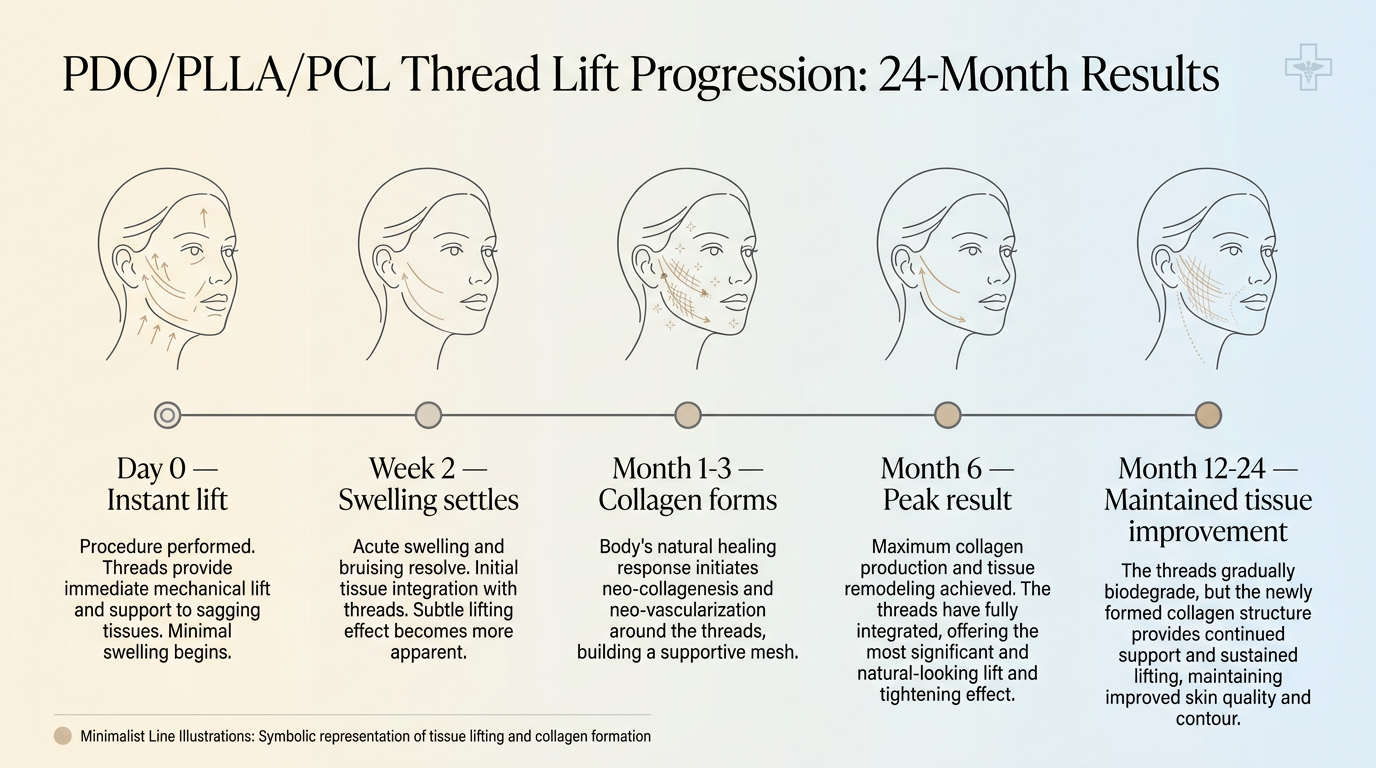
Day 0 — Immediate Post-Treatment
Visible mechanical lift. Mild swelling and erythema. Patient should avoid mirrors for emotional reasons in the first 24 hours, as swelling can mask the true result.
Week 1–2 — Swelling Resolution
Swelling subsides. The "drop" patients sometimes perceive is the resolution of inflammatory edema, not loss of lift. Counsel patients in advance.
Month 1–3 — Collagen Formation Window
Fibroblast activation peaks. New collagen forms along the thread path. Visible improvement in skin density and contour.
Month 6 — Peak Result
Mechanical and biological effects fully integrated. This is when patients send testimonials and book follow-up consultations.
Month 12–24 — Sustained Maintenance
For PCL: tissue improvement is maintained as polymer slowly resorbs. For PLLA: approaching maintenance window. For PDO: re-treatment already required.