Mastering Filler Injections with Blunt Micro Cannulas
Introduction: The Evolution of Aesthetic Injection Tools
The history of aesthetic medicine is a fascinating journey of innovation, moving from primitive, often dangerous methods to the highly refined, science-backed procedures we see today. In the early 20th century, the quest for facial rejuvenation led to the use of substances like paraffin and liquid silicone, which were often injected with large-bore, industrial-style needles. These early attempts frequently resulted in granulomas, infections, and severe tissue distortion, highlighting the desperate need for both safer materials and more sophisticated delivery systems.
As the field transitioned into the modern era with the development of bovine collagen in the 1980s and the subsequent revolution of hyaluronic acid (HA) fillers in the late 1990s, the standard tool remained the sharp hypodermic needle. While effective for precision, the sharp needle inherently carries risks—namely, its ability to pierce blood vessels and nerves, leading to bruising, hematomas, and the much-feared complication of vascular occlusion.
The real paradigm shift occurred in the early 2000s with the introduction of the Blunt Cannula, often referred to as a Micro Cannula. This tool was designed specifically to address the limitations of sharp needles in the delicate landscape of the human face. By replacing the sharp point with a rounded, blunt tip, practitioners could navigate through subcutaneous tissues with significantly less trauma. Today, brands like Aurothread have perfected the design of these Aesthetic Injection Tools, offering Auro Blunt Cannulas that provide unparalleled control and safety. This guide explores the deep technicalities of these tools and why they have become the gold standard for dermal filler administration.
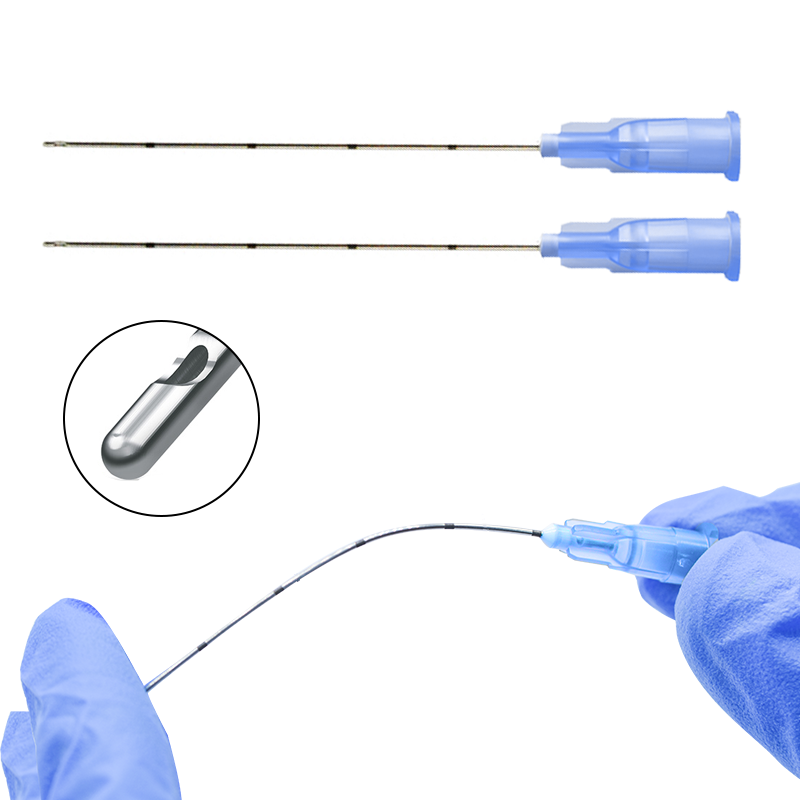
Defining the Tool: What is a Blunt Cannula?
A Blunt Cannula is a flexible, thin tube with a non-sharp, rounded tip. Unlike a needle, which cuts through tissue, a cannula is designed to slide through the skin layers, pushing aside blood vessels and nerves rather than piercing them. To understand its efficacy, one must look at its four primary anatomical components:
1. The Hub (Luer Lock)
The hub is the base of the cannula that attaches to the syringe. High-quality Auro Blunt Cannulas utilize a universal Luer lock system, ensuring a secure, leak-proof connection even when high-viscosity fillers are being extruded. The hub is often color-coded according to the gauge (e.g., orange for 25G, grey for 27G), allowing for quick identification in a busy clinical setting.
2. The Shaft
The shaft of a micro cannula is constructed from medical-grade stainless steel. What sets products like the Auro Blunt Cannula apart is the specific balance of flexibility and rigidity. The shaft must be flexible enough to navigate the natural curves of the face, such as the jawline or cheekbones, but rigid enough to allow the practitioner to direct the tip to the precise anatomical plane (e.g., supraperiosteal or subcutaneous).
3. The Blunt Tip
The hallmark of the Blunt Tip Needle is its atraumatic rounded end. This design is the primary safety feature. When the cannula encounters a resistance like a vein or artery, the blunt tip "bounces" off or slides past the structure rather than puncturing it. This significantly reduces the incidence of internal bleeding and intravascular injection.
4. The Side Port
Because the tip is blunt, the filler cannot exit from the end. Instead, it is delivered through a precision-drilled side port located just a few millimeters from the tip. The geometry of this port is critical; it is engineered to ensure a smooth, consistent flow of product, minimizing the "spurting" effect and allowing for the creation of smooth, even boluses or retrograde threads.
The Great Debate: Sharp Needle vs. Blunt Cannula
The choice between a needle and a cannula is not always binary; many expert injectors use both in a single session. However, understanding the deep-dive comparison is essential for any practitioner looking to optimize their outcomes.
The Sharp Needle: Precision with a Price
Sharp needles are excellent for "fanning" in very superficial layers or for placing tiny "droplets" of filler in specific spots, such as the Cupid’s bow of the lips. Because they are sharp, they require no "pilot hole" and can enter the skin at any point. However, their primary disadvantage is the risk of trauma. Every pass of a needle is a potential cut through a capillary or a larger vessel. In high-risk "danger zones" like the glabella or the nasolabial fold, a needle carries a statistically higher risk of entering an artery, which can lead to skin necrosis or even blindness if the filler travels retrograde to the ophthalmic artery.
The Blunt Cannula: Safety and Global Volumization
The cannula excels in global rejuvenation and volumization. Because it is longer than a standard needle, a practitioner can treat an entire area—such as the cheek or the jawline—from a single entry point. This reduces the number of "stabs" the patient experiences, leading to a much more comfortable procedure. Clinical studies have consistently shown that patients treated with cannulas report lower pain scores (Visual Analog Scale) and exhibit significantly less ecchymosis (bruising) and edema (swelling) post-procedure.
Clinical Evidence
A landmark cohort study published in JAMA Dermatology analyzed thousands of filler injections and found that the risk of vascular occlusion was significantly lower when using a cannula compared to a needle. While the absolute risk remains low for both in expert hands, the "fail-safe" nature of the blunt tip provides an added layer of security that is invaluable, especially when using high-G' (firmer) fillers like those in the Auro Secret range.
The Benefits: Why Practitioners and Patients Prefer Cannulas
The adoption of Micro Cannulas is driven by three core pillars: Safety, Comfort, and Aesthetics.
1. Enhanced Safety (Prevention of Vascular Occlusion)
Vascular occlusion occurs when filler is accidentally injected into an artery, blocking blood flow to the skin or vital organs. The blunt tip of an Auro Blunt Cannula is designed to be larger than the lumen of most small vessels it encounters, making it physically difficult to enter the vessel. This "tactile feedback" allows the injector to feel resistance and navigate around structures, a sensation that is absent with sharp needles which slice through everything in their path.
2. Superior Patient Comfort
Most patients have a fear of needles. Replacing 10-20 needle pricks with just 2 pilot-hole pricks (one on each side of the face) dramatically reduces the psychological and physical stress of the treatment. Furthermore, as the cannula moves through the subcutaneous space, it creates less "micro-trauma" to the nerve endings, resulting in a procedure that many patients describe as "weird but not painful."
3. Minimal Downtime (Less Bruising and Swelling)
In the "lunchtime procedure" era, patients want to return to work immediately. By avoiding the transection of blood vessels, cannulas minimize the leakage of blood into the surrounding tissues. This means the classic "black and blue" bruising associated with dermal fillers is often entirely avoided, and swelling is kept to a minimum.
4. Artistic Precision and Smooth Transitions
The length of the cannula allows for the "long-thread" technique, where the injector can lay down a continuous, smooth line of filler. This is particularly beneficial for contouring the jawline or creating a seamless transition between the cheek and the tear trough. It prevents the "lumpy" appearance that can sometimes occur with multiple needle boluses.
Clinical Applications: Mastering Different Facial Zones
The versatility of the Auro Blunt Cannula makes it suitable for almost every area of the face. However, the technique and sizing must be adapted for each specific zone.
Tear Troughs (The Under-Eye Area)
This is perhaps the most common area for cannula use. The skin is incredibly thin, and the area is densely populated with vessels. Using a 25G or 27G 38mm cannula allows the injector to place filler deep on the bone (supraperiosteal) while minimizing the risk of a "Tyndall effect" or bruising. The cannula is inserted from the lateral cheek, allowing the tip to reach the medial tear trough safely.
Midface and Cheeks
To restore youthful volume, a 22G or 25G 50mm cannula is ideal. From a single entry point near the zygomatic arch, the injector can address the medial cheek, the lateral cheek, and even the nasolabial fold. This "fanning" technique ensures a natural, lifted look without the need for multiple punctures.
Jawline and Chin Contouring
For the long, straight lines required for a "snatched" jawline, a 70mm cannula is often preferred. This allows the practitioner to navigate the entire length of the mandible in one smooth motion. The 21G or 22G sizes are typically used here to deliver the thicker fillers necessary for structural support.
The Lips
Lip augmentation with a cannula is a specialized technique. While needles are great for the vermilion border, a cannula is excellent for adding volume to the body of the lip (the "pink" part) with zero bruising. It also allows for a more uniform distribution, preventing the "duck lip" look that results from over-concentrated boluses.
Temples
The temples are a high-risk zone due to the superficial temporal artery. A cannula allows for a safer "interfascial" or "subdermal" placement of filler, gliding over the vessels and nerves that reside in this complex anatomical space.
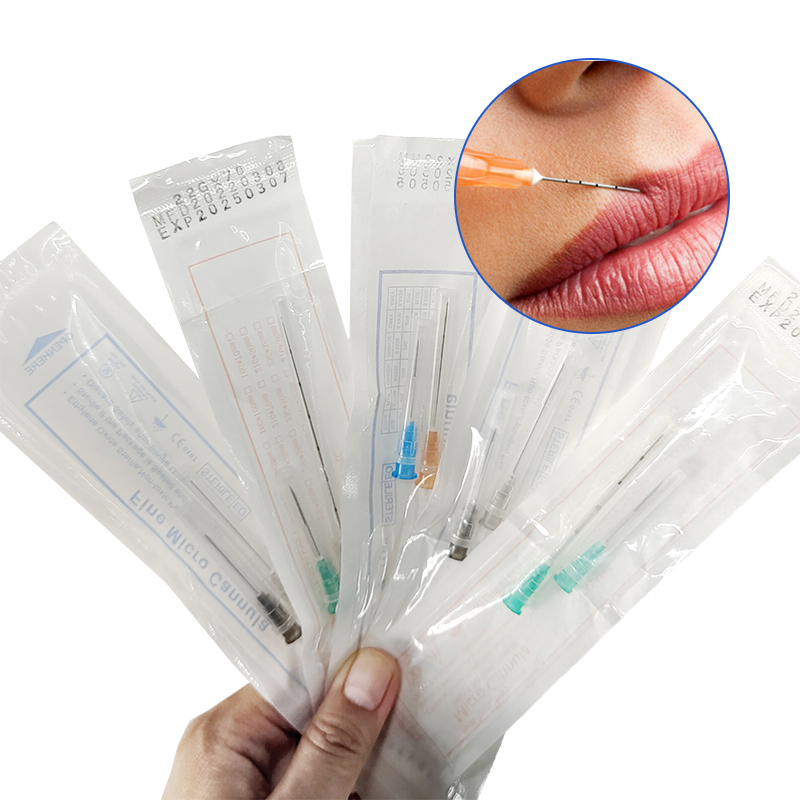
Sizing Guide: Gauges and Lengths Explained
Choosing the right Auro Blunt Cannula is as much a science as it is an art. The "G" stands for Gauge, which refers to the external diameter of the cannula. Interestingly, the higher the number, the thinner the cannula.
Understanding Gauges (21G to 30G)
· 21G & 22G: These are the "powerhouses." They are thick and sturdy, ideal for high-viscosity, highly cross-linked fillers used for deep volumization in the chin, jawline, and deep malar (cheek) fat pads. They offer the highest level of safety against vascular entry.
· 25G: The industry's most popular "all-rounder." It is thin enough to be comfortable for the patient but sturdy enough to provide excellent tactile feedback. It is used for nasolabial folds, cheeks, and even tear troughs.
· 27G: A finer tool for medium-viscosity fillers. Ideal for the lips, fine lines, and the delicate tear trough area. Because it is thinner, it requires a bit more finesse to prevent bending during insertion.
· 30G: The ultra-fine Micro Cannula. Used specifically for skin boosters and very thin HA fillers (like Auro Secret Fine) in areas with extremely thin skin, such as the periorbital or perioral lines.
Understanding Lengths (38mm to 70mm)
· 38mm (1.5 inches): The standard length for most facial applications, providing enough reach to cover a significant area without being unwieldy.
· 50mm (2 inches): Perfect for the mid-face and cheeks, allowing the injector to reach from the lateral aspect of the face to the medial aspect.
· 70mm (2.75 inches): Reserved for long-range contouring, such as the jawline or large-scale body treatments.
Practitioner Tips: Advanced Insertion Techniques
Transitioning from needles to cannulas requires a shift in mindset and technique. Here are the secrets to success with Aesthetic Injection Tools.
1. The Pilot Hole (The Entry Point)
Since the cannula is blunt, it cannot pierce the skin. A "pilot needle" (usually a sharp needle one gauge larger than the cannula) must be used to create a small entry point. Pro Tip: Angle the pilot needle at 45-90 degrees and ensure it penetrates the dermis completely. This makes the insertion of the cannula much smoother.
2. The "Pinch and Slide"
To navigate the cannula easily, use your non-dominant hand to pinch the skin and create a "tent." This helps guide the cannula into the correct plane (subcutaneous or deep) and prevents it from getting "caught" in the dermis.
3. Tactile Feedback (The "Give" and the "Resistance")
The beauty of the Blunt Tip Needle is that you can feel what you are touching. If you feel a "pop," you may have passed through a fascial layer. If you feel strong resistance, you may be hitting a vessel or a nerve—STOP, retract slightly, and change the angle. This "conversational" feedback between the tool and the injector is what makes cannulas so safe.
4. Slow and Steady Extrusion
Always inject while withdrawing the cannula (retrograde injection). This ensures a smooth thread of product and further reduces the risk of intravascular placement, as the tip is moving away from any potential vessels.
Patient Aftercare: Ensuring the Best Results
Even though the Auro Blunt Cannula significantly reduces trauma, proper aftercare is essential for optimal healing and longevity of the Dermal Filler.
· Ice, Ice, Baby: Although bruising is rare with cannulas, some localized swelling is normal. Applying a cold compress for 10 minutes every hour for the first 4-6 hours can further minimize edema.
· Hands Off: Advise patients not to touch, massage, or apply pressure to the treated area for at least 24 hours to prevent the filler from migrating.
· Sleep Elevated: Sleeping with an extra pillow for the first two nights helps fluid drain away from the face, reducing morning puffiness.
· Avoid Heat and Exercise: Saunas, steam rooms, and vigorous exercise should be avoided for 24-48 hours. Heat increases blood flow to the face, which can exacerbate swelling.
· Sun Protection: Direct sun exposure should be avoided until any initial redness or swelling has subsided.
Frequently Asked Questions (FAQs)
1. Is the cannula really safer than a needle? Yes, for most areas. The blunt tip significantly reduces the risk of piercing a blood vessel, which is the primary cause of bruising and vascular occlusion. However, the injector's skill remains the most important factor.
2. Does it hurt to have a cannula inserted? The initial "pilot hole" feels like a quick pinch (similar to a needle). Once the cannula is inside, most patients report a "pressure" sensation rather than pain. Many find it much more tolerable than multiple needle injections.
3. Can you use a cannula for Botox? Typically, no. Botox (Neurotoxins) is usually injected with very fine, sharp needles (30G-32G) because the volumes are tiny and precision placement into specific muscle fibers is required.
4. What happens if the cannula gets stuck? A skilled injector will never force a cannula. If resistance is met, they will partially retract and re-angle. This is the tactile feedback that makes the tool safe.
5. Why do some injectors still use needles? Needles are superior for very fine, superficial work (like vertical lip lines) or for certain "bolus on bone" techniques where absolute pinpoint precision is needed.
6. Are Auro Blunt Cannulas disposable? Yes, all Auro Blunt Cannulas are sterile, medical-grade, and strictly for single-use to ensure patient safety and prevent cross-contamination.
7. Can a cannula be used for fat grafting? Yes, blunt cannulas were originally popularized in liposuction and fat grafting before being miniaturized for dermal fillers.
8. How do I choose the right size? This depends on the filler's thickness and the injection depth. Generally, 22G/25G for volume and 27G for detail. Consult the Aurothread sizing chart for specific recommendations.
Conclusion: The Future of Aesthetic Precision
The shift toward Blunt Cannulas represents the maturity of the aesthetic industry. We have moved from "more is better" to "safer and smarter is better." By choosing high-quality tools like the Auro Blunt Cannula, practitioners can provide their patients with the best of both worlds: stunning, natural-looking results and a procedure that is safe, comfortable, and requires virtually no downtime.
Whether you are a seasoned injector or a patient looking for the safest treatment options, understanding the benefits of the Micro Cannula is essential. In the hands of a skilled professional, this simple stainless steel tool becomes a magic wand, restoring youth and confidence one smooth thread at a time.
Ready to elevate your aesthetic practice with the highest quality tools? Explore the full range of medical-grade Auro Blunt Cannulas and enhance your patient outcomes today.
Shop the Collection: Aurothread Blunt Cannula Collection