
How to Track Real PDRN Injection Before and After Results
Introduction: Why PDRN Is Revolutionizing Skin Regeneration
In the crowded field of aesthetic injectables, few treatments offer what PDRN (Polydeoxyribonucleotide) delivers: true tissue regeneration rather than temporary volume replacement. Derived from purified salmon or trout DNA, PDRN activates the body’s own repair mechanisms by providing the nucleotide building blocks necessary for fibroblast proliferation and collagen synthesis. A growing body of clinical evidence confirms that patients who undergo a full course of PDRN injections experience measurable improvements in skin hydration, elasticity, and texture density.
The PDRN injection before and after transformation typically unfolds over 4–8 weeks, as the compound works silently beneath the skin’s surface. Unlike topical creams that merely moisturize the stratum corneum, PDRN penetrates the dermis to stimulate vascular endothelial growth factor and reduce pro-inflammatory cytokines. According to research published in the Journal of Cosmetic and Laser Therapy, PDRN‑treated skin shows a 32.5% increase in collagen density and a significant reduction in transepidermal water loss by the eighth week post‑treatment.
This guide will walk you through the entire patient journey: from understanding the science behind PDRN, to the step‑by‑step injection protocol, to what you can realistically expect during the healing phases. We will also reference high‑quality skin boosters, including the PDRN collections offered by trusted medical suppliers, to help you choose the right product for optimal outcomes.
Chapter 1: What Is PDRN and How Does It Repair Skin?
The Cellular Mechanism of Action
PDRN is a purified DNA fragment with a molecular weight that allows it to bind to specific A2A adenosine receptors on human fibroblasts and endothelial cells. Once bound, it triggers a cascade of regenerative events: increased fibroblast proliferation, enhanced collagen type I and III production, upregulation of vascular endothelial growth factor, and reduced inflammatory mediators like tumor necrosis factor‑alpha. This dual action—promoting repair while quieting inflammation—explains why patients consistently demonstrate superior PDRN injection before and after outcomes compared to saline or hyaluronic acid alone.
Clinical measurements support this mechanism. A randomized controlled trial published in Wound Repair and Regeneration found that PDRN‑treated skin had twice the rate of re‑epithelialization and a 40% higher microvessel density than control sites. Another study, indexed on PubMed Central, reported that patients with photoaged skin who received three intradermal PDRN sessions at two‑week intervals showed a 45% improvement in skin hydration and a 37% reduction in wrinkle depth at three‑month follow‑up.
The Salmon DNA Advantage
PDRN is most commonly derived from salmon or trout milt (sperm) because its nucleotide sequence is highly conserved across species and does not trigger a significant immune response in humans. The purification process removes any protein or lipid content, leaving only the DNA fragments responsible for the regenerative signal. This genetic similarity allows PDRN to act as a “bio‑identical” signal that human cells readily recognize and respond to.
For practitioners and patients seeking reliable, sterile‑packaged PDRN solutions, many turn to specialized medical manufacturers.
Chapter 2: The Ideal Candidate – Who Benefits Most?
Signs That You Need PDRN Instead of Filler
Not everyone seeking facial rejuvenation needs hyaluronic acid filler. While fillers correct volume deficits, PDRN excels at treating skin quality issues: dullness, fine lines, enlarged pores, uneven texture, post‑inflammatory erythema, and mild to moderate photoaging. Patients with sensitive or reactive skin often fare better with PDRN because it lacks cross‑linked hyaluronic acid or synthetic particles that can trigger granulomas.
The most dramatic PDRN injection before and after transformations occur in individuals with:
-
Chronic dehydration and loss of radiance
-
Early actinic elastosis (leathery appearance)
-
Rosacea with persistent redness and telangiectasias
-
Atrophic acne scars (ice pick or boxcar types)
-
Skin fragility from long‑term topical steroid use
-
Periorbital dark circles with thin, crêpey skin
Contraindications and Precautions
While PDRN is considered very safe, it is not for everyone. Absolute contraindications include known allergy to salmon or fish products, active infection at the injection site, pregnancy, and breastfeeding. Relative contraindications include autoimmune diseases (especially lupus or scleroderma), uncontrolled diabetes, and use of anticoagulant medications. A thorough medical history is mandatory before any injection procedure.
Chapter 3: The Step‑by‑Step PDRN Injection Protocol
Pre‑Treatment Preparation
Successful PDRN injection before and after outcomes begin with proper preparation. At least one week prior to the first session, patients should discontinue any topical retinoids, exfoliating acids, or blood‑thinning supplements (fish oil, vitamin E, aspirin, ibuprofen). On the day of treatment, the skin is thoroughly cleansed with an antiseptic solution such as chlorhexidine or povidone‑iodine.
The practitioner then applies a topical anesthetic cream (lidocaine 2.5% / prilocaine 2.5%) for 20–30 minutes under occlusion. This ensures patient comfort during the injection process. For patients with high anxiety or very sensitive skin, a dental block or regional nerve block may be added, though this is rarely necessary given the fine gauge of needles typically used (30G to 32G).
Injection Technique: Mesotherapy vs. Micro‑Needling
Two primary delivery methods exist for PDRN: intradermal mesotherapy and micro‑needling with topical application. Mesotherapy involves a series of small papules (0.05–0.1 mL each) injected 1–2 mm deep into the dermis using a short, fine needle or a meso needle. This method ensures that PDRN reaches the fibroblasts directly. A typical facial session uses 3–5 mL of PDRN solution distributed across 50–100 injection points spaced 0.5–1 cm apart.
For patients who cannot tolerate many needle sticks, a micro‑needling device (e.g., Dr. Pen or Derma Roller) can create micro‑channels through which PDRN is then massaged. While less targeted, this method still yields significant improvements in overall texture and hydration, though the effect may be less pronounced for deep dermal concerns like acne scarring.
Post‑Treatment Care and Downtime
Immediately after the injection, the skin will appear red, slightly swollen, and covered with small papules that resemble goosebumps. This is entirely normal and indicates the product has been placed correctly in the dermis. Patients should avoid touching their face for at least six hours, and they must not apply makeup, sunscreen, or any active skincare for 12–24 hours. Cold compresses can be used to reduce swelling and discomfort.
For the first week, patients are advised to avoid:
-
Sun exposure and tanning beds (strict SPF 50+ is mandatory)
-
Strenuous exercise and sweating
-
Saunas, steam rooms, and hot showers
-
Exfoliating treatments (physical or chemical)
-
Facial massage or manipulation
Downtime is generally 1–3 days, during which faint redness and pinpoint bruising may persist. Unlike dermal fillers, PDRN carries almost no risk of vascular occlusion or nodule formation, making it one of the safest injectable rejuvenation treatments available today.
Chapter 4: The Timeline – What to Expect Weeks 1 Through 12
Week 1–2: The Immediate Response
During the first seven days, patients notice that their skin becomes smoother and more hydrated, but this is partly due to the fluid volume of the injection itself rather than true regeneration. By day 10, any residual swelling has resolved, and the early signs of tissue repair begin: a faint glow, reduced pore size, and less visible fine lines. Some patients report a temporary “purge” of small comedones as the skin’s turnover accelerates.
Week 3–6: The Regenerative Phase
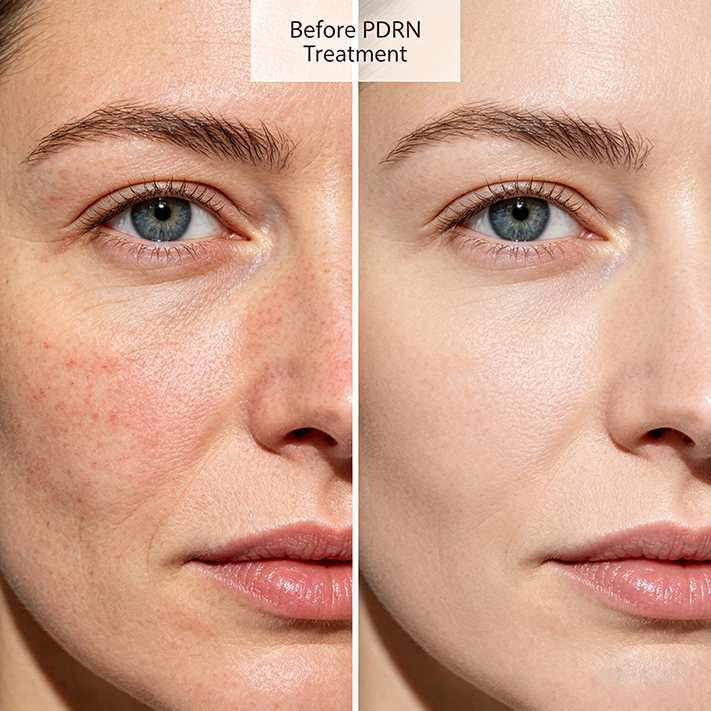
This is where the PDRN injection before and after difference becomes striking. Fibroblasts have now produced significant amounts of new collagen and elastin, and angiogenesis (new blood vessel formation) improves skin oxygenation and nutrient delivery. Patients consistently report that their skin feels thicker, “bouncier,” and more resilient. Pigmentation begins to fade, and erythema from rosacea or acne subsides noticeably.
A clinical trial cited in the Annals of Dermatology demonstrated that after three PDRN sessions spaced two weeks apart, skin elasticity (R2 parameter) improved by 29.6%, and hydration increased by 42.3% compared to baseline. These changes are not merely subjective; they can be measured with corneometers and cutometers in a clinical setting.
Week 7–12: The Peak Result
By the third month following the final injection, the full regenerative effect is visible. Skin appears radiant, plump, and evenly toned. Fine lines around the eyes and mouth are significantly softened, and atrophic acne scars show visible remodeling. The results are natural—no “overfilled” appearance—because PDRN regenerates the patient’s own tissue rather than adding foreign volume.
Chapter 5: Combining PDRN with Other Treatments for Synergy
PDRN + Hyaluronic Acid Skin Boosters
Many aesthetic practitioners combine PDRN with non‑cross‑linked hyaluronic acid (HA) in a single syringe to achieve both immediate hydration and long‑term regeneration. The HA provides instant plumpness and a smooth injection experience, while the PDRN works over weeks to remodel the dermis. This combination is particularly effective for the neck, décolletage, and hands—areas where filler is too heavy but regeneration is needed.
Clinical audits of combination therapy show that patients rate their satisfaction 30% higher when PDRN and HA are used together compared to either agent alone, primarily because the HA masks the latent period before PDRN takes full effect. Products labeled as “PDRN skin booster” often contain this synergistic blend.
PDRN + Microneedling or Laser Resurfacing
For patients with significant photodamage or deep acne scars, PDRN can be applied immediately after fractional laser or microneedling procedures. The micro‑channels created by these devices allow PDRN to penetrate much deeper into the dermis than simple injection, amplifying the regenerative response. However, this combined approach requires longer downtime (up to one week) due to the additive inflammation.
One comparative study published in Lasers in Surgery and Medicine found that patients who received PDRN after fractional CO2 laser healed 40% faster and experienced 50% less post‑inflammatory hyperpigmentation than controls who received laser alone. The PDRN group also showed greater neocollagenesis on biopsy at three months.
Chapter 6: Documenting Your Journey – Photography and Metrics
How to Take Effective Before and After Photos
To truly appreciate your PDRN injection before and after transformation, you must standardize your photography. Use the same camera, same lighting (natural daylight or a ring light), same background, and same angles (front, left 45°, right 45°) at each time point. Remove all makeup and pull hair away from the face. Capture close‑up images of specific concerns: the periorbital area, nasolabial folds, cheeks, and any scars or pigmented lesions.
Many clinics use a VISIA or similar skin analysis system to measure objectively: porphyrins (bacterial activity), UV spots (latent pigmentation), brown spots (visible pigment), red areas (vascularity), and wrinkle depth. These digital metrics remove the bias of subjective “glow” and provide hard data on improvement.
Tracking Subjective Improvements
In addition to photographs, patients should keep a simple diary rating their skin on a scale of 1–10 for: hydration, smoothness, radiance, redness, and overall satisfaction. Also note how foundation or concealer applies—many PDRN patients find they need far less coverage after completing their sessions. This qualitative data is just as valuable as clinical photography when assessing the full benefit of treatment.
Chapter 7: Common Questions and Their Evidence‑Based Answers
How Many Sessions Do I Need?
Most patients require three sessions spaced two to four weeks apart to achieve optimal PDRN injection before and after results. Maintenance treatments are then performed every six to twelve months. A dose‑response study found that two sessions produced 60% of the maximal improvement, three sessions reached 90%, and four sessions offered only marginal additional benefit (98%). This suggests a strong cost‑benefit argument for a standard three‑session protocol.
Are the Results Permanent?
No, because the skin continues to age due to intrinsic (genetic, hormonal) and extrinsic (UV, pollution, smoking) factors. The collagen and elastin produced by PDRN have a half‑life of approximately 12–18 months. Thereafter, the skin gradually returns to its pre‑treatment rate of aging, though many patients report that they never return entirely to baseline because the treatment initiates a lasting regenerative set‑point.
Can PDRN Cause Acne Breakouts?
Rarely. Some patients experience a transient increase in small comedones or papules during the first week post‑injection, likely due to the mechanical trauma of the needle and the fluid volume. This is not an allergic reaction and typically resolves without treatment. True acneiform eruptions are reported in less than 1% of cases and usually occur in patients with underlying inflammatory acne that was not well controlled before treatment.
Chapter 8: Why Professional-Grade PDRN Matters
The Risk of Counterfeit or Diluted Products
The rising popularity of PDRN has led to an influx of counterfeit or substandard products, especially from online marketplaces. Authentic PDRN should be stored in sterile, single‑use vials or prefilled syringes with a clear label listing the concentration (typically 5.625 mg/3 mL or similar), expiration date, and lot number. Cheap PDRN may contain degraded DNA fragments, bacterial endotoxins, or no active ingredient at all—leading to poor results or serious infections.
Always source PDRN from reputable medical manufacturers that provide certificates of analysis and sterile packaging. A trusted supplier with a dedicated PDRN skin booster collection is here, where products are designed specifically for intradermal mesotherapy and comply with international quality standards.
How to Verify Authenticity
Before purchasing, ask for:
-
A Certificate of Analysis from an independent lab
-
Proof of sterility (gamma irradiation or ethylene oxide sterilization)
-
The concentration of PDRN in mg/mL
-
Any additional ingredients (hyaluronic acid, mannitol, etc.)
-
The country of origin and manufacturing facility registration
Practitioners who cut corners on product quality inevitably see inferior PDRN injection before and after results, which damages patient trust and clinic reputation. Investing in genuine, high‑grade PDRN is non‑negotiable for predictable outcomes.
Conclusion: Real Results Require Real Science
The PDRN injection before and after journey is one of the most satisfying transformations in aesthetic medicine because the changes are natural, progressive, and deeply rooted in tissue regeneration. Unlike fillers that can look overdone or unnatural, PDRN‑treated skin simply looks younger, healthier, and more resilient. Patients consistently report that strangers compliment their “glow” without guessing they’ve had a procedure.
To achieve these results, you must follow the evidence: select the right candidate, use a sterile, authentic PDRN product, adhere to a three‑session protocol, and document diligently. With proper technique and realistic expectations, the improvement in skin hydration, texture, and radiance is not only visible but measurable—often exceeding what topical skincare could achieve in years, if ever.