
Decoding the 7 Mechanisms of PDRN Skin Booster Therapy with Auro HYDRO PDRN
Auro HYDRO PDRN elevates this science through a triple-action formulation: polynucleotides (PDRN) for cellular regeneration, sodium hyaluronate for deep hydration, and niacinamide for melanin regulation and barrier enhancement [product page]. This synergistic combination addresses the complete spectrum of skin aging: texture, tone, elasticity, and barrier function.
The global clinical trial landscape reflects this shift. A 2026 randomized trial is actively investigating the efficacy of a 0.2% PDRN, 2% hyaluronic acid, and 0.1% niacinamide combination for periocular wrinkle treatment, with outcomes measured by 3D imaging and epigenetic markers . This is the precise formulation architecture of Auro HYDRO PDRN—validating its scientific foundation.
This guide deconstructs the seven distinct mechanisms by which Auro HYDRO PDRN achieves comprehensive skin regeneration, supported by peer-reviewed data and regulatory context.
Begin by reviewing Auro HYDRO PDRN formulation specifications here .
Mechanism 1: Adenosine A2A Receptor Activation – The Cellular "On Switch"
The Science: PDRN exerts its primary biological effects through activation of the adenosine A2A receptor, a G-protein-coupled receptor expressed on fibroblasts, keratinocytes, and endothelial cells . Adenosine receptors are evolutionarily conserved sensors of tissue stress and damage. When activated, they initiate a cascade of downstream effects: increased cyclic AMP, enhanced cell proliferation, and modulated inflammation.
Clinical Implication: This receptor-level engagement distinguishes PDRN from passive moisturizers. It is not merely sitting on the skin; it is signaling skin cells to behave more youthfully.
The Auro HYDRO PDRN Differential: The polynucleotides in Auro HYDRO PDRN are processed to optimal chain lengths for receptor binding affinity. The formulation ensures that these active fragments remain bioavailable upon intradermal injection, maximizing A2A receptor engagement .
Data Point: A 2025 KoreaMed review confirmed that PDRN's dual mechanisms—A2A activation and salvage pathway nucleotide provision—underpin its regenerative efficacy across wound healing and aesthetic applications .
Authority Link: The National Institutes of Health (NIH) database indexes over 200 peer-reviewed publications on PDRN's receptor-mediated mechanisms. Read NIH Mechanistic Overview of PDRN .
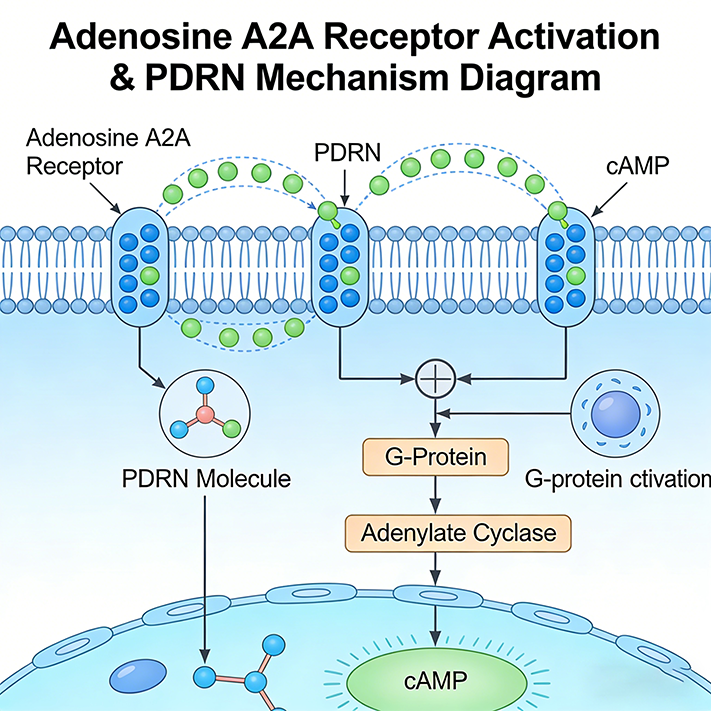
Mechanism 2: Salvage Pathway Nucleotide Provision – Building Blocks for Repair
The Science: Beyond receptor signaling, PDRN supplies exogenous nucleotides that enter the salvage pathway of DNA synthesis . Cells undergoing division or repair require nucleotides for DNA replication and RNA transcription. By providing these building blocks directly, PDRN reduces the metabolic burden on stressed or aging cells.
Clinical Implication: This is particularly relevant in photoaged skin, where chronic UV exposure has depleted cellular energy reserves and damaged mitochondrial DNA. PDRN effectively "fuels" the repair process.
The Auro HYDRO PDRN Differential: Auro HYDRO PDRN contains purified sodium DNA (PDRN) fragments of optimized molecular weight distribution [product page]. Recent research demonstrates that low-molecular-weight PDRN fragments (below 200 base pairs) exhibit superior biological activity, enhancing cell proliferation by up to 129.9% in keratinocytes and 125.2% in fibroblasts .
Safety Consideration: The FDA emphasizes that dermal fillers and injectables should only be administered by licensed practitioners familiar with facial anatomy . PDRN skin boosters, while generally safe, require proper injection technique.
Authority Link: The FDA's dermal filler guidance outlines patient selection criteria and warns against purchasing unregulated products online. Read FDA Dermal Filler Patient Information .
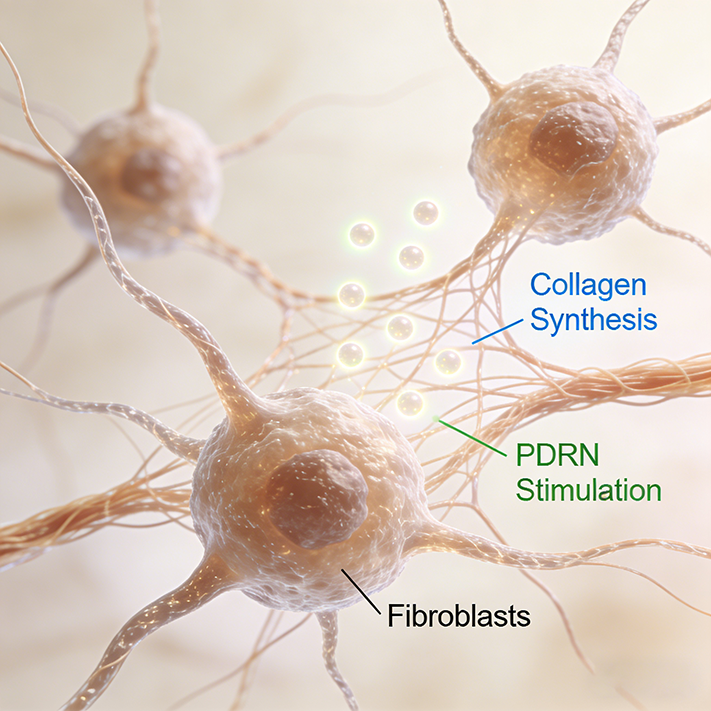
Mechanism 3: Fibroblast Proliferation and Collagen Synthesis
The Science: Fibroblasts are the workforce of the dermis, responsible for producing Type I and III collagen, elastin, and extracellular matrix components. With aging and photoexposure, fibroblast density declines, and remaining fibroblasts become senescent—they stop dividing and secrete inflammatory mediators rather than structural proteins.
PDRN directly stimulates fibroblast proliferation and upregulates collagen gene expression. A 2025 study demonstrated that low-molecular-weight PDRN significantly increased expression of COL1A1 (Type I collagen), COL5A1, ELN (elastin), and FBN1 (fibrillin) .
Clinical Implication: Increased collagen density translates to measurable improvements in skin elasticity, firmness, and wrinkle reduction. Unlike topical retinoids that work primarily on epidermis, injected PDRN targets the dermal foundation.
The Auro HYDRO PDRN Differential: The formulation's ability to enhance fibroblast activity is complemented by its hyaluronic acid component, which provides immediate hydration and creates a favorable extracellular environment for collagen deposition [product page].
Authority Link: Verywell Health's review of PDRN treatments confirms that clinical evidence supports collagen stimulation and improved skin elasticity, though patients should maintain realistic expectations. Read Verywell Health PDRN Overview .
Mechanism 4: Keratinocyte Differentiation and Epidermal Barrier Enhancement
The Science: Skin aging is not limited to the dermis. The epidermis—the outermost barrier—thins with age, leading to increased transepidermal water loss (TEWL), dryness, and sensitivity. Keratinocytes, the predominant epidermal cells, require proper differentiation to form an intact stratum corneum.
PDRN enhances keratinocyte proliferation and differentiation, upregulating key barrier proteins including filaggrin (FLG), involucrin (IVL), occludin (OCLN), and Type VII collagen (COL7A1) . These proteins form the cornified envelope and tight junctions essential for barrier function.
Clinical Implication: Enhanced barrier function means skin that retains moisture, resists irritants, and appears smoother and more radiant.
The Auro HYDRO PDRN Differential: The inclusion of niacinamide (Vitamin B3) in Auro HYDRO PDRN synergizes with PDRN's barrier-enhancing effects. Niacinamide is well-established to increase ceramide synthesis and reduce TEWL [product page].
Data Point: A clinical study demonstrated that topical low-molecular-weight PDRN applied for 2 weeks markedly reduced TEWL in a sodium lauryl sulfate-induced skin damage model, confirming accelerated barrier recovery .
Authority Link: The KoreaMed-indexed review confirms PDRN's dual effects on both dermal and epidermal compartments. Read KoreaMed PDRN Review .
Mechanism 5: Anti-Inflammatory and Antioxidant Activity
The Science: Chronic low-grade inflammation—termed "inflammaging"—drives many age-related skin changes. UV exposure generates reactive oxygen species (ROS) that activate inflammatory transcription factors (NF-κB), leading to production of pro-inflammatory cytokines (IL-1β, IL-6, TNF-α) and matrix metalloproteinases (MMPs) that degrade collagen .
PDRN suppresses key inflammatory mediators while reducing ROS levels . This dual anti-inflammatory and antioxidant activity protects both the extracellular matrix and cellular components.
Clinical Implication: Reduced inflammation means less redness, less sensitivity, and slower degradation of collagen and elastin.
The Auro HYDRO PDRN Differential: The formulation's anti-inflammatory effects are enhanced by its hyaluronic acid base, which itself modulates inflammatory responses through CD44 receptor interactions [product page].
Advanced Research: A 2025 study on PDRN-spermidine nanoparticles demonstrated that PDRN formulations potently inhibited TNF-α, IL-6, and MMP-1 expression while increasing cellular mitochondrial ATP by 46.14% —evidence of enhanced cellular energy status .
Authority Link: PubMed-indexed research confirms PDRN's role in modulating inflammatory pathways relevant to skin aging. Read PubMed PDRN Nanoparticle Study .
Mechanism 6: Angiogenesis and Microcirculation Enhancement
The Science: Healthy skin requires adequate blood supply for nutrient delivery and waste removal. With aging, the dermal microvasculature becomes sparser and less efficient. This compromises fibroblast function and slows wound healing.
PDRN promotes angiogenesis—the formation of new blood vessels—through A2A receptor activation on endothelial cells . Enhanced vascularity means improved oxygenation, nutrient delivery, and metabolic waste clearance.
Clinical Implication: Better microcirculation translates to healthier skin color, faster healing after procedures, and improved tolerance of other active treatments.
The Auro HYDRO PDRN Differential: The injectable delivery of Auro HYDRO PDRN ensures that polynucleotides reach the dermal microvasculature, where they can exert maximal angiogenic effects .
Clinical Context: A 2026 clinical trial protocol specifically includes PDRN-based treatments delivered via intradermal injection or microneedling, with outcomes measured by 3D imaging and photoaging scales .
Authority Link: The ICH GCP clinical trials registry provides detailed protocols for ongoing PDRN research, offering transparency into study methodologies.
Mechanism 7: Melanogenesis Regulation and Skin Brightening
The Science: Uneven pigmentation—age spots, post-inflammatory hyperpigmentation, and overall dullness—results from dysregulated melanin production and distribution. Melanocytes become hyperactive in response to UV and inflammation.
Niacinamide, a key component of Auro HYDRO PDRN, inhibits melanosome transfer from melanocytes to keratinocytes, reducing visible pigmentation without cytotoxic effects on melanocytes.
Clinical Implication: Regular treatment leads to more even skin tone, reduced hyperpigmentation, and increased radiance—the "skin booster glow."
The Auro HYDRO PDRN Differential: The triple combination of PDRN (regeneration), hyaluronic acid (hydration), and niacinamide (brightening) creates comprehensive skin quality improvement unmatched by single-ingredient products .
Clinical Trial Validation: The ongoing Brazilian trial specifically evaluates a formulation containing 0.2% PDRN, 2% hyaluronic acid, and 0.1% niacinamide for periocular wrinkle treatment—the same therapeutic architecture as Auro HYDRO PDRN .
Authority Link: The ICH GCP registry provides comprehensive eligibility criteria and outcome measures for this active clinical trial. Read ICH GCP Periocular Wrinkle Trial .