
Cannula vs Needle for Fillers: The Complete Gauge & Safety Guide
The debate between using a cannula versus a needle for dermal filler injections is one of the most important discussions in aesthetic medicine. Both instruments have distinct advantages, limitations, and specific clinical applications. According to a 2026 review in Plastic and Aesthetic Nursing, needles allow for rapid, precise injections and are suitable for shallow, targeted applications; however, their sharp points pose a higher risk for misplacement, vascular damage, and tissue trauma. Conversely, cannulas significantly reduce the potential for perforating blood vessels due to their blunt tips and thus provide a safer alternative for use in areas with a dense vascular network .
A comprehensive analysis from the American Med Spa Association notes that soft tissue filler was injected more than 3.4 million times in 2020 alone. As this number continues to grow, training providers to be proficient with both needles and cannulas has become a priority . A 2021 study in JAMA Dermatology analyzing data from 320 dermatologists found that the incidence of vascular occlusion was 1 in 6,410 for needle injections and 1 in 40,882 for cannula injections of dermal filler, suggesting a significantly lower risk with cannulas . This guide synthesizes evidence from authoritative sources including the NIH PubMed database, ScienceDirect, and clinical expertise from board-certified dermatologists. For practitioners seeking high-quality cannulas, Aurothread's blunt cannula collection offers sterile, professionally manufactured options in various gauges.
Understanding the Tools: Needles and Cannulas
A hypodermic needle is a sharp, hollow instrument with a beveled tip designed to pierce the skin and deposit filler at the tip end. Needles allow for precise, direct placement of filler and are familiar to most practitioners from other medical procedures. They come in various gauges, with smaller numbers indicating larger diameters (e.g., 22G is larger than 30G). Needles can be used for precise supraperiosteal placement and are excellent for treating fine lines and superficial wrinkles. However, the sharp tip can cut through blood vessels, leading to bruising and, in rare cases, vascular occlusion .
A microcannula is a blunt-tipped, flexible metal tube with a side port (lumen) near the tip. The blunt tip is designed to displace blood vessels and nerves rather than cut through them. Cannulas are inserted through a pilot hole created by a sharp needle (typically 18G-21G), which means only one or two entry points are needed to treat a large area . Cannulas vary in flexibility and length, typically ranging from 1 to 2 inches. While they are generally considered safer, practitioners must use proper technique. According to the American Med Spa Association, because a cannula pushes tissue aside, an injector may not reach the intended depth, potentially placing filler a few millimeters behind the target site if they are not careful .
Gauge Selection: How to Choose the Right Size
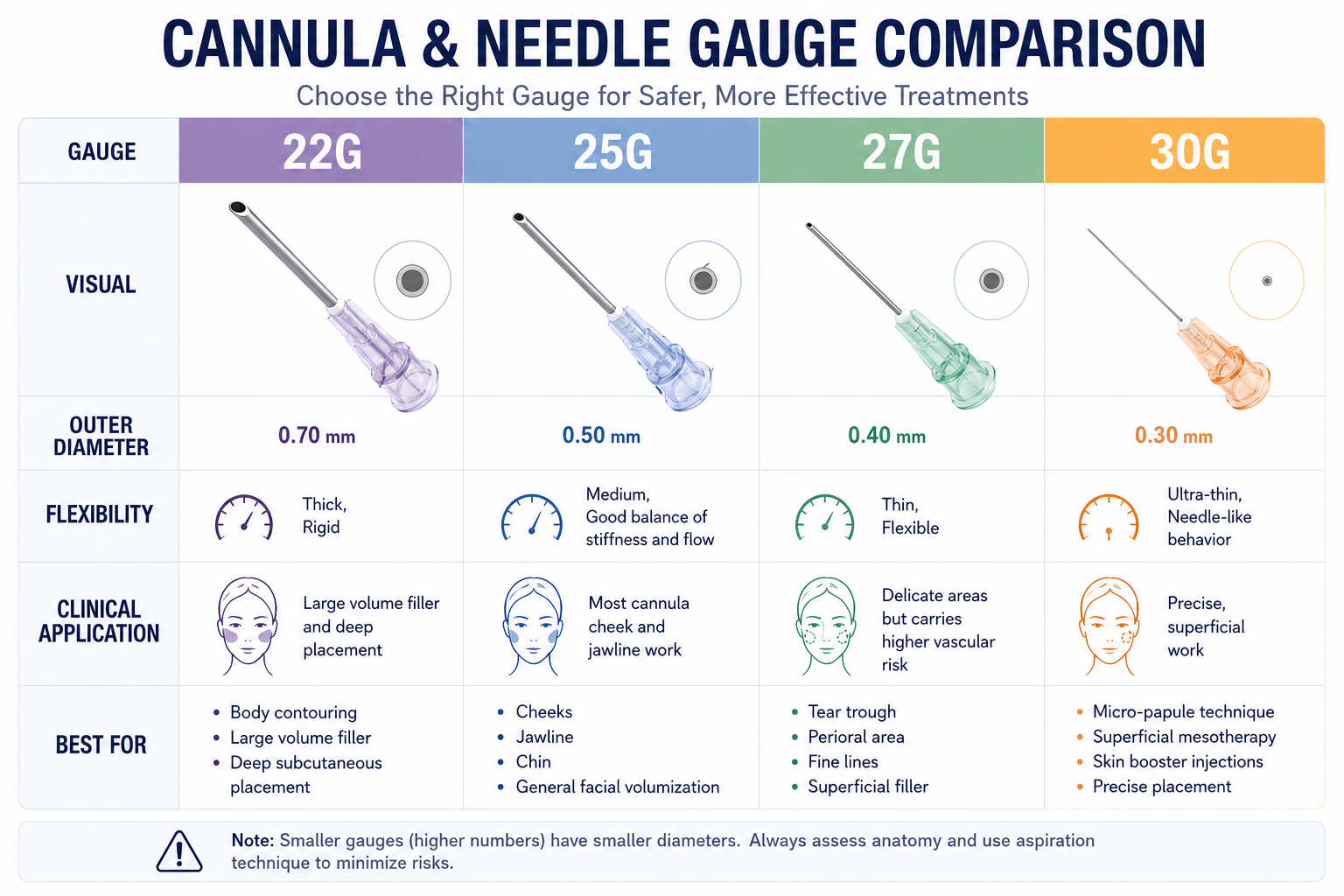
Gauge selection is critical for both safety and efficacy. The smaller the gauge number, the larger the cannula's outer diameter and the stiffer it tends to be.
Cannula Gauges for Aesthetics:
-
22G – Thick & Rigid: A 22-gauge cannula is widely considered the safest option for cannula work. According to the Next Steps in Dermatology review, forces required for arterial wall penetration significantly decreased with smaller diameter cannulas; larger diameter cannulas like 22G require greater forces for intraarterial penetration . Dr. Terrence Keaney recommends a 22-gauge cannula for soft tissue injection, advising practitioners to "keep the cannula moving" to avoid vascular complications .
-
25G – Medium & Balanced: This is a workhorse gauge for many practitioners. It offers a good balance between thickness (safety) and flexibility, making it suitable for midface, jawline, and temple injections.
-
27G – Thin & Flexible: While more flexible, 27G cannulas carry a higher risk. According to the American Med Spa Association, Dr. Steven Weiner no longer uses 27-gauge cannulas because "they have been shown to be a little more pointed, needle-esque, and need almost the same pressure to get into a vessel as a needle of the same size" .
-
30G – Ultra-Thin & Needle-Like: At this gauge, a cannula behaves very similarly to a needle. Dr. Binder from Binder Dermatology notes that 27 and 30 gauge cannulas are "so flexible that in my opinion they start behaving like a needle," and he almost never uses them . Their use can negate the primary safety advantage of a cannula.
Needle Gauges for Aesthetics:
-
30G: The most common needle for precise, superficial filler injection in areas like fine lines and the vermilion border.
-
27G: Used for larger volume filler, allowing for easier extrusion.
Choosing the right gauge for the filler's rheological properties is also important. A viscous filler will require a larger gauge (e.g., 22G) to allow for smooth extrusion without excessive pressure .
Safety Profile: Vascular Occlusion and Bruising
The most significant difference between needles and cannulas is their safety profile, particularly regarding vascular complications. A 2021 study in JAMA Dermatology of 320 dermatologists showed a substantially lower incidence of vascular occlusion with cannulas: 1 in 40,882 injections versus 1 in 6,410 for needles .
A 2026 review published in ScienceDirect analyzed numerous studies and concluded that across multiple sources, cannulas are associated with lower rates of bruising and a reduced signal for vascular occlusion in high-risk, vessel-dense regions . The review cites a study by Hexsel et al. (Level Ia evidence) which found that cannula use significantly reduced the incidence of bruising and vascular complications compared to needles . However, the ScienceDirect review also cautions that cannulas are not risk-free; arterial wall penetration and ischemic events remain possible with improper plane selection, excessive injection pressure, or inadequate anatomical control .
The concept of "vessel bounce" is central to cannula safety. The blunt tip laterally displaces vessels, preventing penetration. However, smaller gauge cannulas (27G or 30G) require less force to penetrate a vessel, increasing the risk. As noted in the Next Steps in Dermatology analysis, "the more narrow the microcannula, the more potential to cause neurovascular injury or even to penetrate a blood vessel if passed through tissue with inappropriate force" . Despite these caveats, the weight of evidence supports the use of cannulas to reduce bruising and vascular complications.
Clinical Applications: When to Use Needle vs. Cannula
The choice between needle and cannula should be guided by the treatment area, the specific aesthetic goal, and the practitioner's expertise.
When to Use a Cannula:
Cannulas are generally preferred for broader areas requiring diffuse volume restoration. According to the American Med Spa Association, experienced injectors frequently choose cannulas for the prezygomatic space, jawline, temples, mid-face, nasolabial folds, and corners of the mouth. The single entry point and blunt tip reduce trauma, swelling, and bruising in these vascular areas. Dr. Weiner notes that treating the lateral cheek with a cannula can be done "in a minute and a half per side" through a single entry point, whereas a needle approach might require multiple entry points, each with a risk of bruising .
When to Use a Needle:
Needles retain a distinct advantage for precision. "If you're trying to treat really fine lines, get a needle," says Dr. Weiner. "You can't treat them superficially with a cannula" . Needles are also preferred for the vermilion border, cupid's bow, and columella, where precise, superficial placement is required. The American Med Spa Association also notes that for the nose, a needle may be safer than a cannula due to the curvature of the radix, which can shift a cannula out of the safe supraperiosteal plane . In areas like the deep pyriform, a needle down to the periosteum is often recommended for precise structural support.
Combination Technique: Many experts advocate for using both instruments in the same patient. A practitioner might use a cannula for broad distribution in the midface and then use a needle to fine-tune the result or treat a specific line. This combination approach offers the best balance of safety and precision .
Procedure Time, Pain, and Patient Experience
Patient experience often differs between the two techniques. While the cannula's movement under the skin can be a novel and sometimes disconcerting sensation, it generally results in less pain and quicker recovery. The American Med Spa Association notes that a cannula's single entry point, versus five or six needle entry points, reduces the potential for bruising and bleeding. Dr. Weiner compares the technique, saying a cannula allows you to "slide it along the periosteum, and you could do it in a minute and a half per side" .
A 2021 study evaluating needle versus cannula for dorsal hand rejuvenation found comparable aesthetic improvement between both techniques but 12% greater patient satisfaction with the cannula technique. The cannula's blunt tip causes less tissue trauma, reducing post-procedure soreness. Dr. Warren notes that with a needle on the periosteum, "it's like taking your elbow and banging it on a table—you have a bone bruise," leading to patient complaints of soreness. In contrast, cannula patients are more likely to say, "I like the way I look," with minimal discomfort .
Furthermore, cannulas minimize product waste. As noted in the American Med Spa Association guide, needles become dull after a few sticks and must be changed, resulting in the loss of 0.05 ccs of product each time. Over a procedure, this can lead to up to a 5% loss of product, which is an economic consideration for clinics . For a comprehensive range of high-quality, sterile cannulas that minimize complications, practitioners can explore Aurothread's blunt cannula collection .
Conclusion: A Tailored Approach for Optimal Results
The decision between using a cannula or a needle is not a binary choice but a strategic decision based on anatomy, product, and desired outcome. Needles offer unparalleled precision for superficial lines, fine wrinkles, and focal periosteal support. Cannulas offer a significant safety advantage by reducing the risk of vascular complications, bruising, and swelling, making them the preferred choice for broad area treatment in vessel-rich regions like the midface, temples, and jawline.
The evidence is clear: both tools are essential for a modern aesthetic practice. A 2026 review in ScienceDirect concludes that "device selection should be individualized to region, indication, and operator skill," recommending preferential cannula use for broad, low-pressure distribution in vessel-dense areas and needle use for targeted structural points . A combination technique often provides the optimal balance of safety and efficacy. Furthermore, the choice of gauge is critical, with the general rule that larger diameter cannulas (e.g., 22G) are safer and should be preferred when anatomically feasible. For practitioners looking to expand their toolkit, Aurothread's blunt cannula collection provides a range of gauges and lengths to suit diverse clinical applications.