
Angelfill PLLA: The Complete Clinical Guide to Long-Lasting Collagen Biostimulation
Introduction: Why the Aesthetics World is Turning to Biostimulators
Over the past decade, the global aesthetic medicine market has undergone a fundamental shift in philosophy. Patients are no longer merely seeking simple "filling" effects; instead, they crave a sense of authenticity and naturalness rooted in biology. Once upon a time, a single injection of Hyaluronic Acid (HA) was the default solution for addressing facial aging; today, however, a deeper and more nuanced conversation is unfolding in clinics worldwide. The question physicians are now being asked is no longer, "Can you fill this in?" but rather, "Can you stimulate my body's own regenerative capabilities?"
This is precisely the core issue that Poly-L-Lactic Acid (PLLA)—marketed under the brand name Angelfill—was developed to address. Unlike traditional dermal fillers, which merely create the illusion of volume by mechanically displacing tissue, PLLA is a true collagen biostimulator. It does not introduce exogenous volumetric material into the body; instead, it instructs the body's own fibroblasts to rebuild the structural protein matrix that serves as the very foundation of youthful skin.
Section 1: What is Angelfill PLLA? Understanding the Chemistry
Angelfill is a brand of injectable PLLA filler. Its core active ingredient—Poly-L-Lactic Acid (PLLA)—is a synthetic, biodegradable, and highly biocompatible polymer derived from lactic acid (the very same compound produced within your muscles during exercise). This is neither a novel nor an experimental material; in fact, PLLA has a proven track record of over 40 years of medical application, commonly utilized in products such as absorbable sutures, surgical patches, and orthopedic fixation screws.
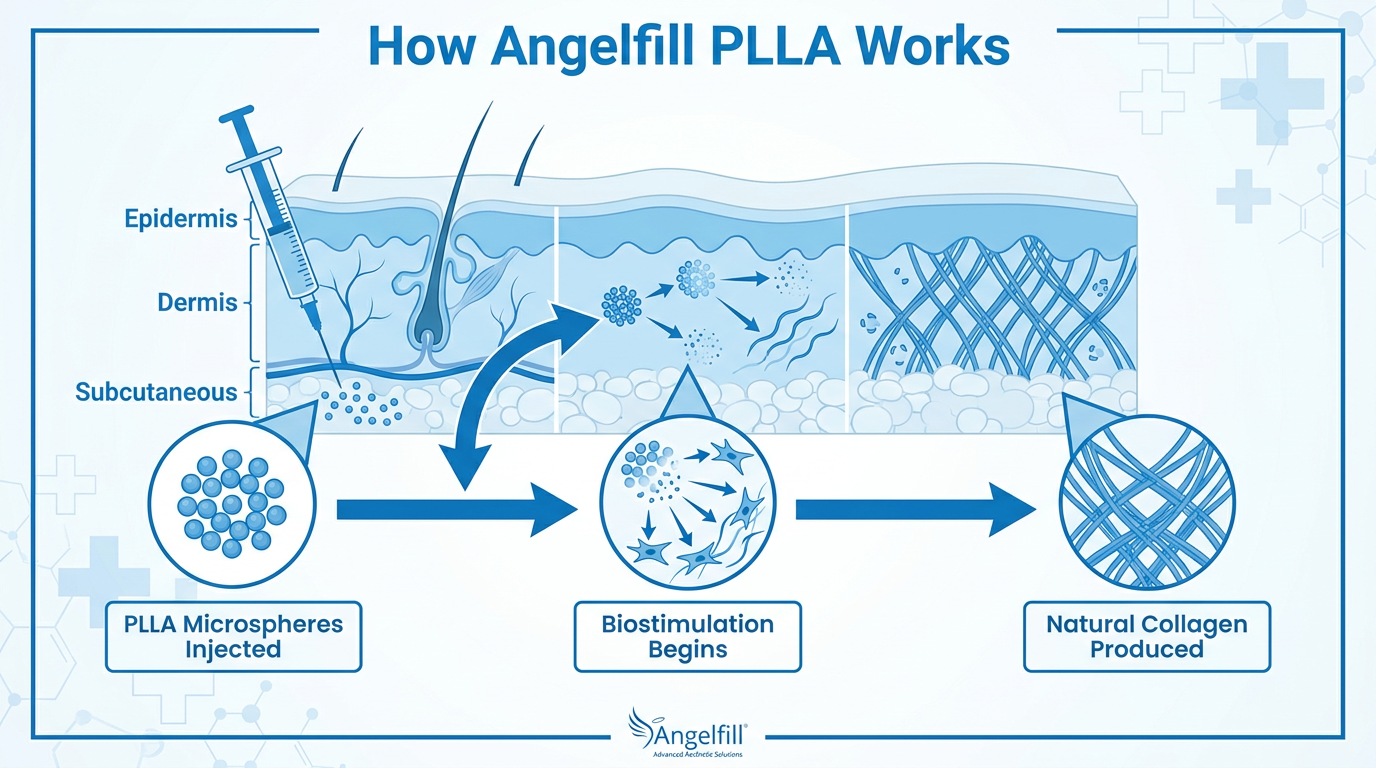
Each vial of Angelfill contains 150 milligrams of PLLA microspheres, presented in the form of a lyophilized (freeze-dried) powder. Prior to use, the product must be reconstituted with sterile water for injection or a lidocaine solution and allowed to stand for several hours (for optimal results, overnight standing is recommended) to ensure complete hydration. Following injection, these microspheres disperse evenly throughout the deep dermis and subcutaneous tissue layers, where they initiate a series of synergistic biological regenerative and reparative processes.
Section 2: The Biology of Collagen Biostimulation
To appreciate why Angelfill delivers such durable results, one must understand the biology at play. Human skin derives its structural integrity primarily from Type I and Type III collagen fibers, which are produced by cells called fibroblasts in the dermis. Starting in our mid-twenties, collagen production declines at a rate of approximately 1% per year. By age 50, this cumulative deficit manifests as laxity, hollowing, and textural degradation.
When Angelfill PLLA microparticles are deposited into the tissue, the body recognizes them as a foreign material and initiates a controlled, low-grade inflammatory response — a process known as a foreign body reaction. This is not harmful; it is a carefully calibrated biological cascade:
1. Phase 1 — Macrophage Recruitment: Immune cells surround each PLLA microparticle to contain and investigate the intrusion.
2. Phase 2 — Fibroblast Activation: Macrophages release growth factors that recruit fibroblasts to the site. These fibroblasts begin synthesizing new collagen.
3. Phase 3 — Neocollagenesis: Over the following weeks and months, a dense network of new collagen fibers forms around and between the reabsorbing PLLA particles, creating genuine structural volume.
4. Phase 4 — Complete Absorption: The PLLA particles gradually hydrolyze into water and carbon dioxide — completely natural metabolic byproducts — leaving behind only the patient's own collagen.
This is the critical distinction: the result is the patient's own biology, not a foreign substance. There is nothing artificial remaining in the tissue at the end of the process.
Section 3: Angelfill vs. HA Fillers — A Clinical Comparison
Hyaluronic acid fillers remain the most commonly performed injectable procedure globally, and for good reason: they are reversible, immediately visible, and highly versatile. However, for specific clinical goals, PLLA represents a categorically superior choice.
|
Feature |
Angelfill PLLA |
Standard HA Filler |
|
Mechanism |
Biostimulation (collagen induction) |
Mechanical volume replacement |
|
Onset of Results |
Gradual (4–12 weeks) |
Immediate |
|
Duration |
2–3 years |
6–18 months |
|
Natural Appearance |
Extremely natural (endogenous collagen) |
Good, but can appear "filled" |
|
Reversibility |
Non-reversible (biodegrades naturally) |
Reversible with hyaluronidase |
|
Best For |
Global volume loss, skin laxity |
Targeted, precise volume |
|
Sessions Needed |
2–3 initial sessions |
1 session (repeatable) |
Experienced practitioners often combine both modalities: Angelfill to rebuild the structural foundation and HA to refine specific features. This layered approach represents the current gold standard for comprehensive facial rejuvenation.
Section 4: Versatile Treatment Areas
One of Angelfill's most compelling clinical advantages is its exceptional versatility. While most HA fillers are engineered for specific facial zones, the unique mechanism of PLLA biostimulation makes it appropriate for a remarkably wide range of body areas where collagen loss and tissue laxity occur.
Face
The face is the primary indication for Angelfill PLLA. Age-related volume loss in the temples, mid-face, and cheeks creates a characteristic "deflated" appearance. PLLA restores this global volume over a period of months, producing a result that is virtually indistinguishable from the patient's own youthful anatomy. The jawline and pre-auricular region also respond exceptionally well, improving facial contour and definition without the risk of migration common to some HA products.
Neck (Décolletage)
The neck and décolletage are often called the "forgotten zones" of anti-aging — areas that betray a patient's age even when the face has been expertly rejuvenated. The skin in this region is thin and subject to constant movement, making it poorly suited to standard fillers. PLLA's mechanism of stimulating intrinsic collagen production makes it ideal here, improving skin thickness, texture, and elasticity without adding palpable filler material.
Hands
Aging hands are a common cosmetic complaint, characterized by prominent tendons and vessels due to volume loss over the dorsum. Angelfill PLLA effectively restores the youthful fullness of the hand dorsum, providing results that outlast HA alternatives and eliminate the need for frequent touch-up appointments.
Body, Buttocks, and Beyond
PLLA has a well-established track record for non-surgical buttock augmentation (the "PLLA BBL"), providing natural lift and volume over multiple sessions. It is also used across the body for skin laxity concerns, including the inner arms, abdomen, and inner thighs — areas where collagen loss and gravitational changes create a crepe-like skin texture that is difficult to address by other non-surgical means.
Section 5: The Treatment Protocol — What to Expect
Consultation
A thorough consultation is the cornerstone of a successful PLLA treatment. The practitioner will assess the degree of volume loss, skin laxity, and the patient's overall health. Medical history is essential — PLLA is contraindicated in patients with active skin infections, autoimmune disorders, or known hypersensitivity to any component. Realistic expectations must be set: unlike HA fillers, results are not instantaneous and develop progressively over 2–3 months.
Reconstitution
Proper reconstitution of Angelfill is critical to achieving optimal, nodule-free results. The standard protocol involves adding 5–8ml of sterile water for injection (often with lidocaine for patient comfort) to the lyophilized powder and allowing it to hydrate for a minimum of 24 hours before use. Vigorous agitation immediately before injection ensures an even suspension of microparticles.
The Injection Session
Angelfill is injected using a cannula or needle into the deep dermis and superficial subcutaneous plane. A dilute, fanning injection technique disperses the microparticles evenly throughout the treatment area. A single session typically takes 30–45 minutes. Most practitioners recommend a protocol of 2–3 sessions spaced 4–6 weeks apart for initial treatment, followed by a maintenance session every 12–18 months.
Immediate Post-Treatment
Immediately after injection, the treated area appears volumized due to the reconstitution fluid. Patients and practitioners must understand that this initial volume will diminish over the first 1–2 weeks as the fluid is absorbed — this is completely normal and expected. The true collagen-stimulated result will emerge gradually over the following months.
Section 6: Timeline of Results — Patience Rewarded
One of the most important aspects of patient counseling for PLLA treatment is managing the timeline of visible results. This is fundamentally different from the instant gratification of HA fillers, and patients who understand this journey are invariably more satisfied with the outcome.
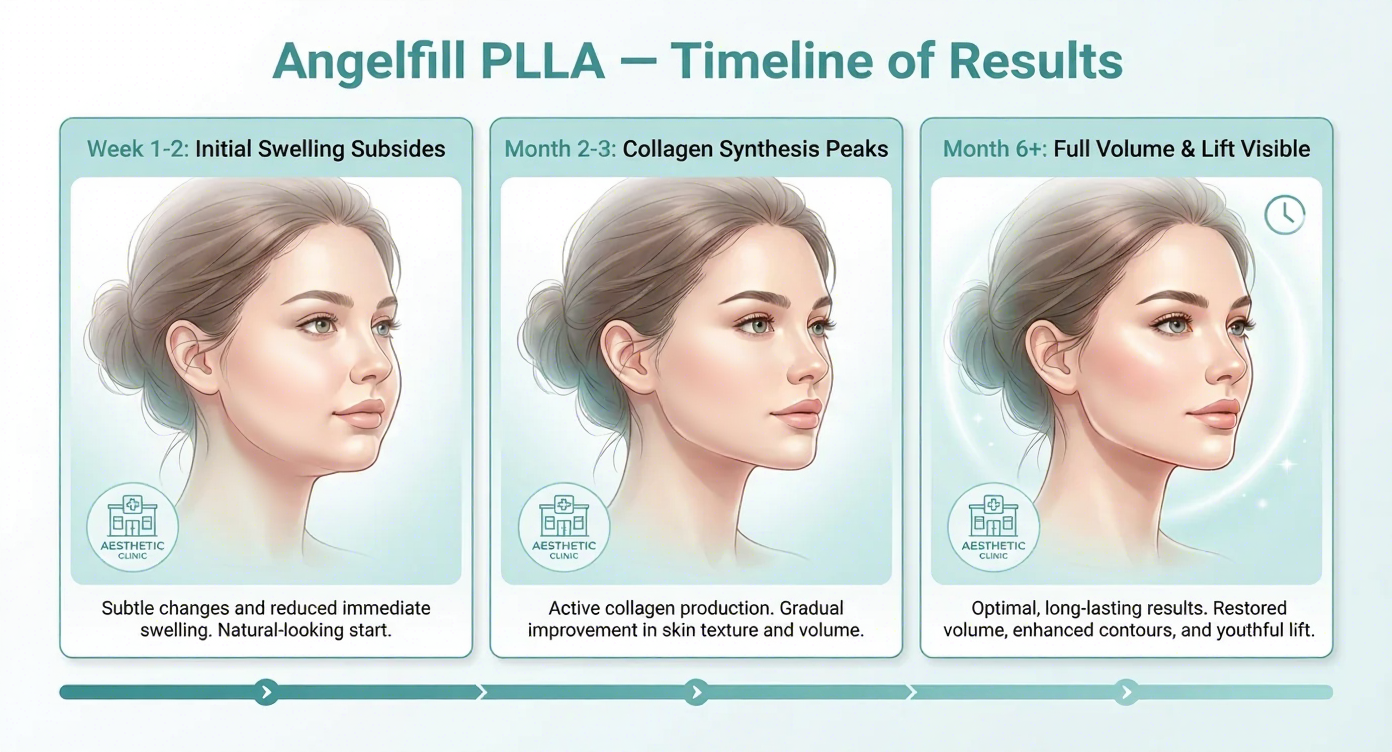
· Week 1–2: Initial fluid volume diminishes. Mild bruising or swelling resolves. The skin begins to feel subtly firmer as the inflammatory cascade initiates.
· Month 1–2: Fibroblast activation is at its peak. Patients may notice improved skin quality and early tightening even before significant volume is apparent.
· Month 2–3: Collagen synthesis is in full progress. Visible improvement in volume and contour becomes apparent, particularly in areas of previous hollowing.
· Month 4–6: Results continue to mature. The tissue feels completely natural and integrated — indistinguishable from the patient's own anatomy.
· Month 6–36: Full, optimal results are maintained. The PLLA particles have fully resorbed; only the patient's endogenous collagen remains, sustaining the result for up to 3 years.
Section 7: Safety Profile and Contraindications
Angelfill PLLA has an extensive clinical safety record. Its biocompatible and biodegradable nature ensures no permanent foreign material remains in the body. However, as with any injectable procedure, an understanding of the safety profile is essential.
Common Side Effects
The most frequently observed post-treatment effects are those common to all injectables: redness, bruising, swelling, and tenderness at the injection site. These are transient and typically resolve within 3–7 days. Practitioners should advise patients to perform a gentle 5-5-5 massage protocol (5 minutes, 5 times a day, for 5 days) post-treatment to ensure even distribution of the microparticles and minimize the risk of nodule formation.
Nodule Prevention
Subcutaneous nodules are the most discussed concern with PLLA. However, these are largely technique-dependent and have become significantly rarer with modern dilution protocols and injection techniques. The key preventive factors are: adequate reconstitution time (minimum 24 hours), sufficient dilution volume, strict avoidance of superficial injection, and the post-treatment massage protocol.
Contraindications
· Active skin infection or inflammation at the treatment site
· Known allergy to PLLA or any components of the formulation
· Pregnancy or breastfeeding
· Autoimmune conditions (relative contraindication; assess case by case)
· Patients with unrealistic expectations of immediate results
Section 8: Combining Angelfill PLLA with Other Treatments
PLLA's mechanism makes it exceptionally complementary to other aesthetic modalities. A well-designed combination protocol can deliver results that no single treatment can achieve alone.
PLLA + PDO Thread Lift
PDO (Polydioxanone) threads provide immediate mechanical lift, while PLLA simultaneously rebuilds the collagen scaffold. This combination addresses both the structural and the biological dimensions of facial aging — the threads lift, and the PLLA ensures the quality and thickness of the tissue that the threads are anchoring improves over time.
PLLA + Energy-Based Devices
High-Intensity Focused Ultrasound (HIFU) and radiofrequency (RF) devices create controlled thermal injury in the SMAS and dermis, stimulating collagen at a different depth than injected PLLA. Used in combination, these modalities create a multi-layer collagen induction effect that comprehensively addresses all planes of tissue laxity.
PLLA + HA Fillers
The most common combination in clinical practice. PLLA is used in a first appointment to address global volume loss and skin quality, and HA is used in a second session (2–4 weeks later) for precise feature refinement — lips, tear troughs, specific contour points. This "framework and feature" approach is becoming the new standard of care for comprehensive facial rejuvenation.
Section 9: Frequently Asked Questions (FAQ)
Q1: How is Angelfill PLLA different from Sculptra?
Both are PLLA-based biostimulators operating on the same biological principle of collagen induction. Angelfill is positioned as a high-quality, competitively priced clinical-grade alternative with a 150mg concentration per vial, offering practitioners a cost-effective option without compromising the clinical efficacy of PLLA technology.
Q2: How many sessions of Angelfill will I need?
Most treatment protocols recommend 2–3 initial sessions spaced 4–6 weeks apart. The number of vials per session depends on the area being treated and the degree of volume loss. Your practitioner will assess this during your consultation.
Q3: Does the treatment hurt?
Angelfill is typically reconstituted with lidocaine to minimize discomfort during injection. A topical anesthetic cream can also be applied beforehand. Most patients describe the sensation as mild pressure — significantly less uncomfortable than many other injectable procedures.
Q4: Can I combine PLLA with HA fillers in the same session?
While possible, most practitioners prefer to separate the two procedures by 2–4 weeks. This allows the initial swelling from PLLA to resolve, providing a clearer clinical picture for any subsequent HA refinement work.
Q5: What aftercare is required following Angelfill treatment?
The most important aftercare step is the 5-5-5 massage protocol. Patients should also avoid strenuous exercise, saunas, and direct UV exposure for 48–72 hours post-treatment. Arnica supplements or topical arnica gel can help minimize bruising.
Q6: Is Angelfill safe for all skin types and ethnicities?
Yes. PLLA's mechanism is intrinsic to human biology and is not dependent on skin type or ethnicity. However, practitioners should be mindful of keloid tendencies in certain patient populations when planning treatment, as the biostimulatory response may be more pronounced.
Q7: How long do results truly last?
Clinical data consistently supports a duration of 2–3 years for PLLA-stimulated results. Individual longevity depends on age, lifestyle factors (sun exposure, smoking), metabolic rate, and the number of initial sessions completed. A maintenance session at the 18–24 month mark is recommended to sustain optimal results.
Q8: Can Angelfill be used for non-facial body treatments?
Absolutely. Angelfill is indicated for the neck, décolletage, hands, abdomen, inner arms, thighs, buttocks, and other areas experiencing skin laxity. The "non-surgical PLLA BBL" for buttock enhancement has become particularly popular as a safe, gradual alternative to implant surgery.
Q9: What happens if I am unhappy with the results?
Unlike HA fillers, PLLA is not reversible with an enzyme. However, because results develop gradually and are driven by the body's own biology, truly undesirable outcomes are exceptionally rare when the product is injected by an experienced practitioner following correct protocols. Any nodules that do form can often be resolved with massage, intralesional steroid injections, or in rare cases, incision and drainage.
Q10: Where can I purchase Angelfill PLLA for my clinic?
Angelfill PLLA is available directly through Aurothread's official product page, ensuring authenticity, correct storage, and clinical-grade quality. Always source PLLA products from reputable, medically certified suppliers to protect both your practice and your patients.
Conclusion: Investing in Biology, Not Just Volume
Angelfill PLLA represents a paradigm shift in how we approach aesthetic aging. In a market saturated with products that temporarily fill the visible effects of collagen loss, PLLA addresses the underlying biological cause. The results — gradual, natural, and strikingly durable — reflect the fundamental truth that the most convincing aesthetic outcomes are those born from the body's own restorative capacity.
Whether used as a standalone biostimulator for diffuse volume loss and skin laxity, or as the structural foundation of a comprehensive combination protocol, Angelfill PLLA consistently demonstrates that in aesthetic medicine, the most powerful interventions are often those that work with the body — not against it.
For practitioners building a results-driven, scientifically grounded practice, and for patients seeking durable, natural-looking rejuvenation, Angelfill PLLA represents one of the most compelling additions to the modern aesthetic toolkit.
,Ready to Experience the Angelfill Difference?
Explore our full range of clinical-grade Angelfill PLLA and premium aesthetic solutions, trusted by practitioners worldwide.